
Whitespark’s Local Search Ranking Factors survey is the closest thing local search has to a consensus. Darren Shaw asks the industry’s practitioners to score what moves the local pack, and their answers shape how agencies and local SEO freelancers spend their optimization hours across client profiles. It is expert judgment, carefully collected. We wanted to know how much of it survives contact with Google Business Profile data at scale.
So we treated the survey as a set of hypotheses and tested 17 of its 187 factors against Localo data. Localo is the local marketing platform agencies and freelancers use to track and optimize client profiles at scale. That gives us 16,098 Google Business Profiles, 131,000+ tracked keywords, 111,000+ Google Posts, and 209,000+ customer reviews. Five factors held up, seven did not, and five turned out to matter far more than the survey says.
Below you get the full scorecard, then every verdict with the numbers behind it, and a re-ranked local factors list to work through in order the next time you open a client’s profile.
Our scorecard: 17 factors at a glance
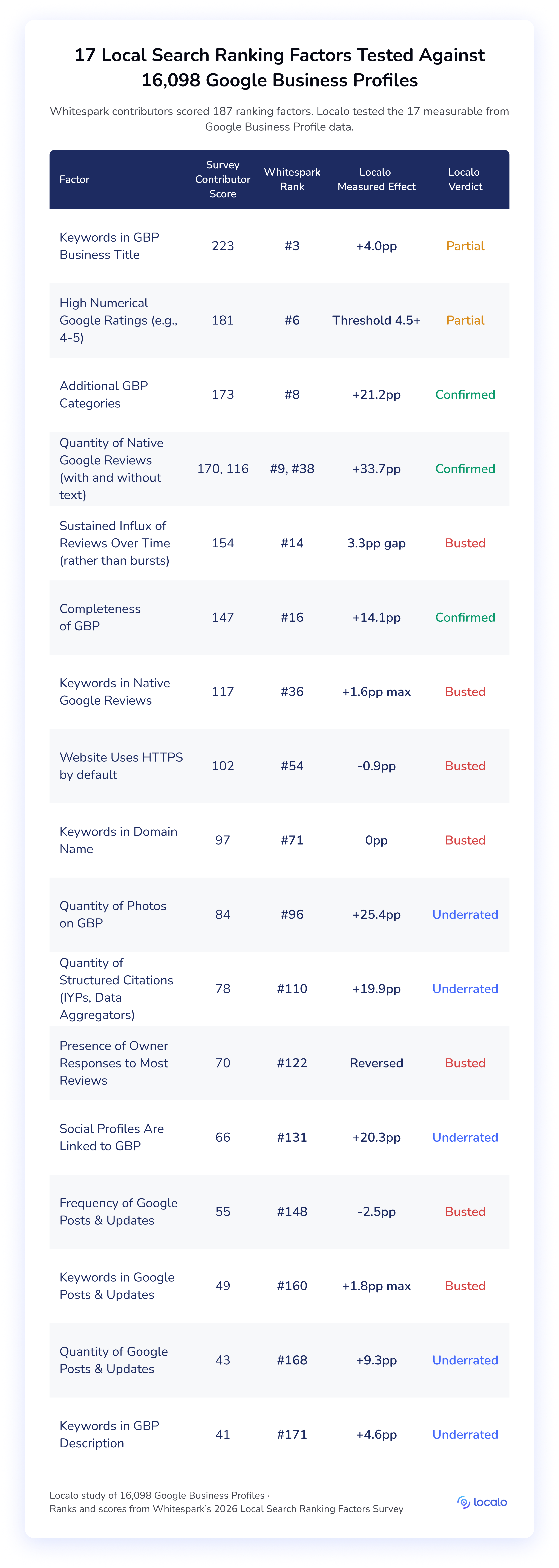
We could not test all 187 factors. Profile data reaches 17 of them, and those are the ones below. The table is sorted by contributor score, where the survey’s top-ranked factor scores 227, with our verdict beside each factor:
- confirmed – Localo’s data supports the claims
- underrated – our data shows a stronger impact than the contributor score suggests
- busted – our data disagrees
- partial – the truth is somewhere in between
Of the 17 factors we tested, 5 were confirmed or partially confirmed, 7 were busted by the data, and 5 turned out underrated.


5 confirmed local search factors
Contributors put these five near the top of the survey, and this is where they were right. Three hold up outright, two with caveats:
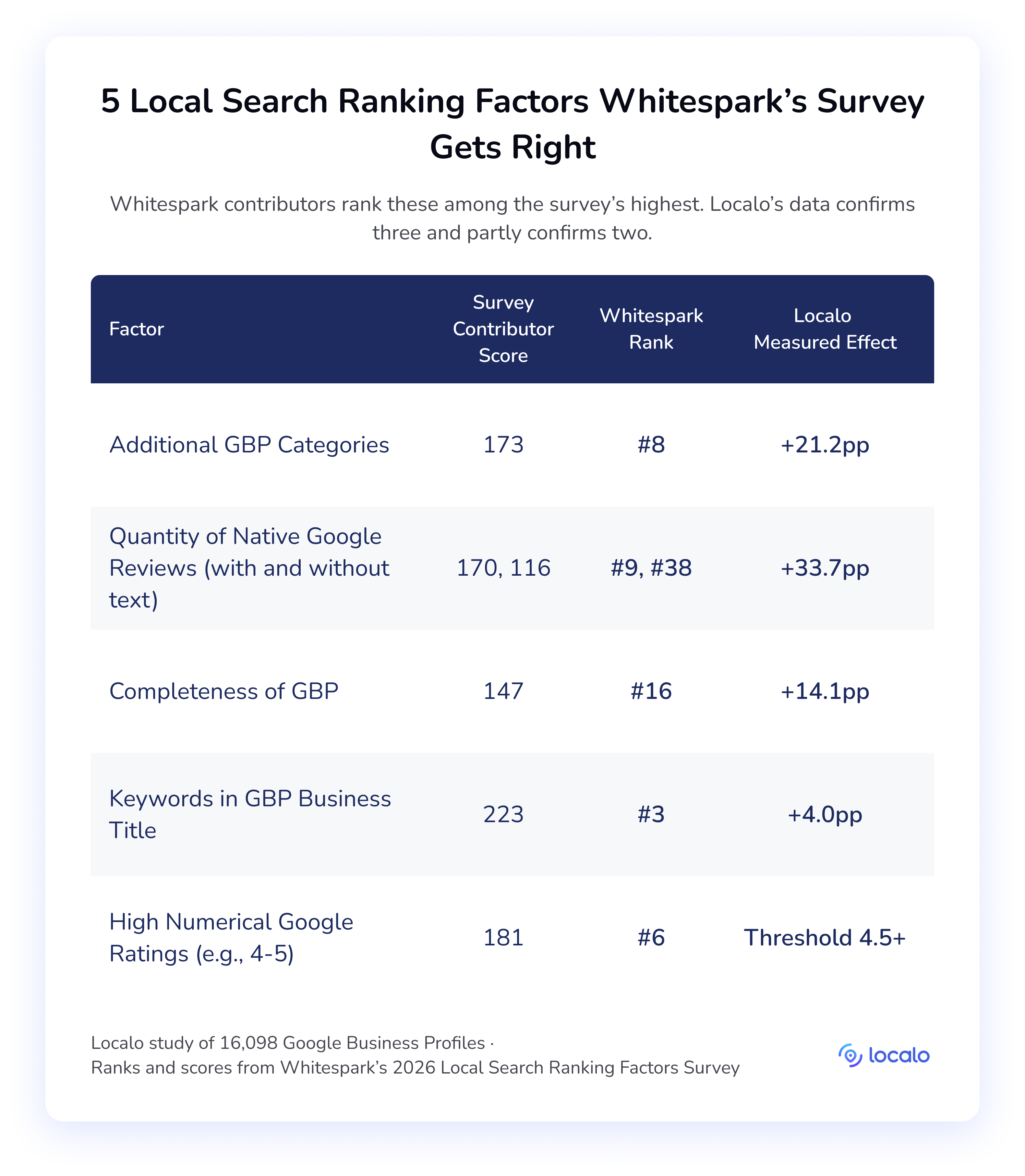
Confirmed: Quantity of native Google reviews (w/text & no text) +33.7pp
Review count produces the widest spread of any factor we measured, so asking customers for Google reviews pays off. Profiles with 201–500 reviews rank top-3 73.0% of the time, against 39.3% at 1–5 reviews. Most of the gain lands early: crossing 10 reviews takes you from 43.1% to 50.8%, and 101–200 reviews already reaches 68.9%.
Confirmed: Additional GBP categories +21.2pp
Adding secondary categories takes one sitting. Profiles with six additional categories rank top-3 69.1% of the time, against 47.9% for profiles with none, a 21.2-point spread. Six is also the ceiling; no higher count beats it.
Confirmed: Completeness of GBP +14.1pp
Completeness is what a local SEO audit is for. Profiles meeting all eight basic criteria (verified address, website, description, at least one additional category, 10+ reviews, 10+ photos, 10+ citations, one social link) rank top-3 72.6% of the time, against a 58.5% baseline across the dataset.
Partially confirmed: Keywords in GBP business title +4.0pp
Contributors rank this third in the whole survey. Against 131,000+ tracked keywords, stem-matched keywords in the GBP title move the top-3 rate by +4.0pp, which lands it ninth of the nine factors we could rank.
Partially confirmed: High numerical Google ratings (e.g., 4-5)
The 4.5 line is real. Profiles rated 4.3–4.4 rank top-3 58.1% of the time; at 4.5–4.6 that jumps to 64.8%. Higher ratings keep helping only slightly, to 69.1% at 4.9, then the rate drops to 53.6% at a perfect 5.0, because a 5.0 usually means very few reviews. We covered this 5.0 Paradox in our ranking factors study.
💡 Here’s what experts got right:
Experts who contributed to Whitespark’s survey correctly identified the top factors: reviews, categories, and profile completeness. However, our data shows that they overrated the impact of title keywords and high ratings.
5 underrated local SEO factors
Five factors sit in the bottom half of the contributor ranking and in the top half of ours. Two of them by a wide margin:
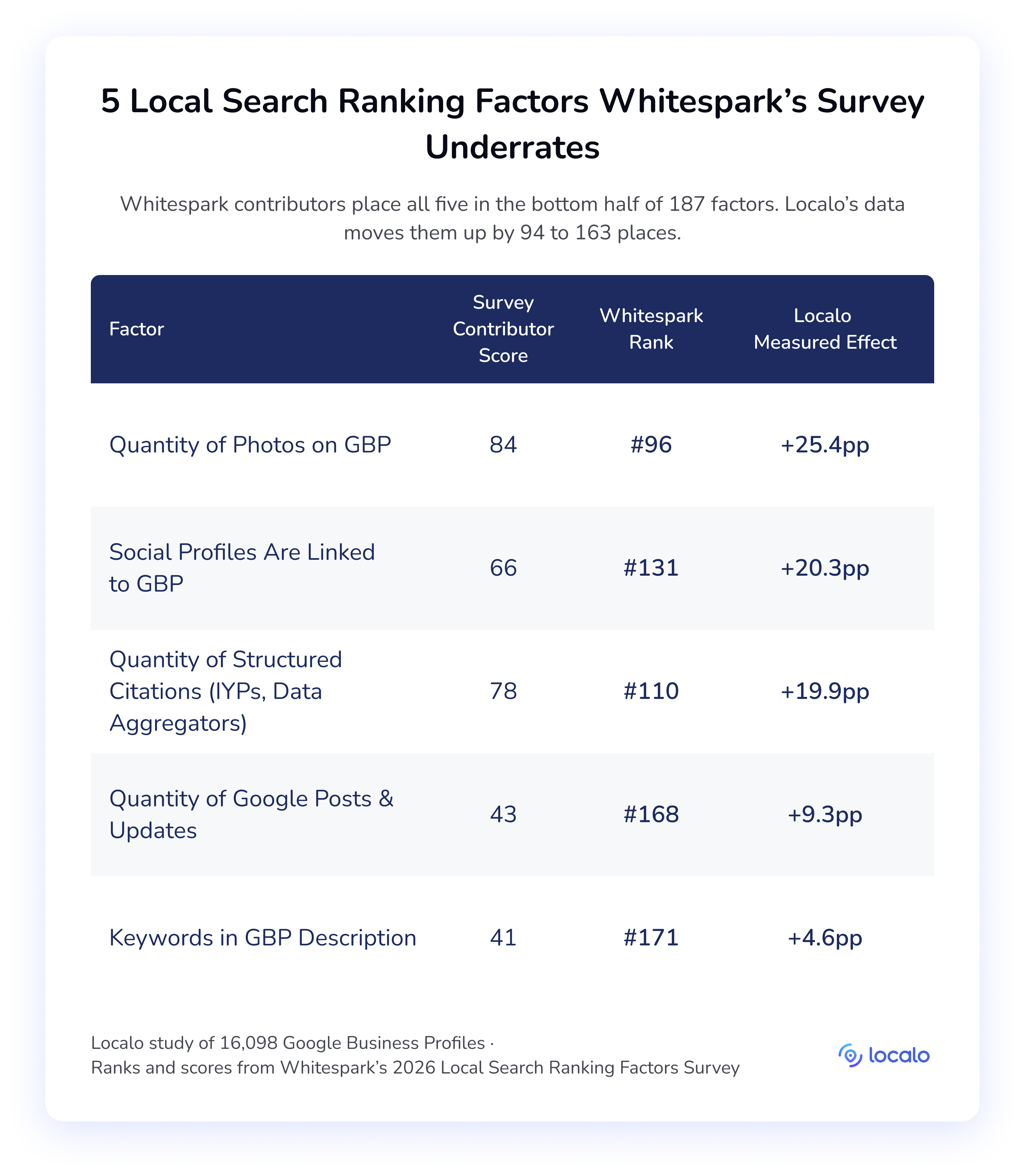
Underrated: Quantity of photos on GBP +25.4pp
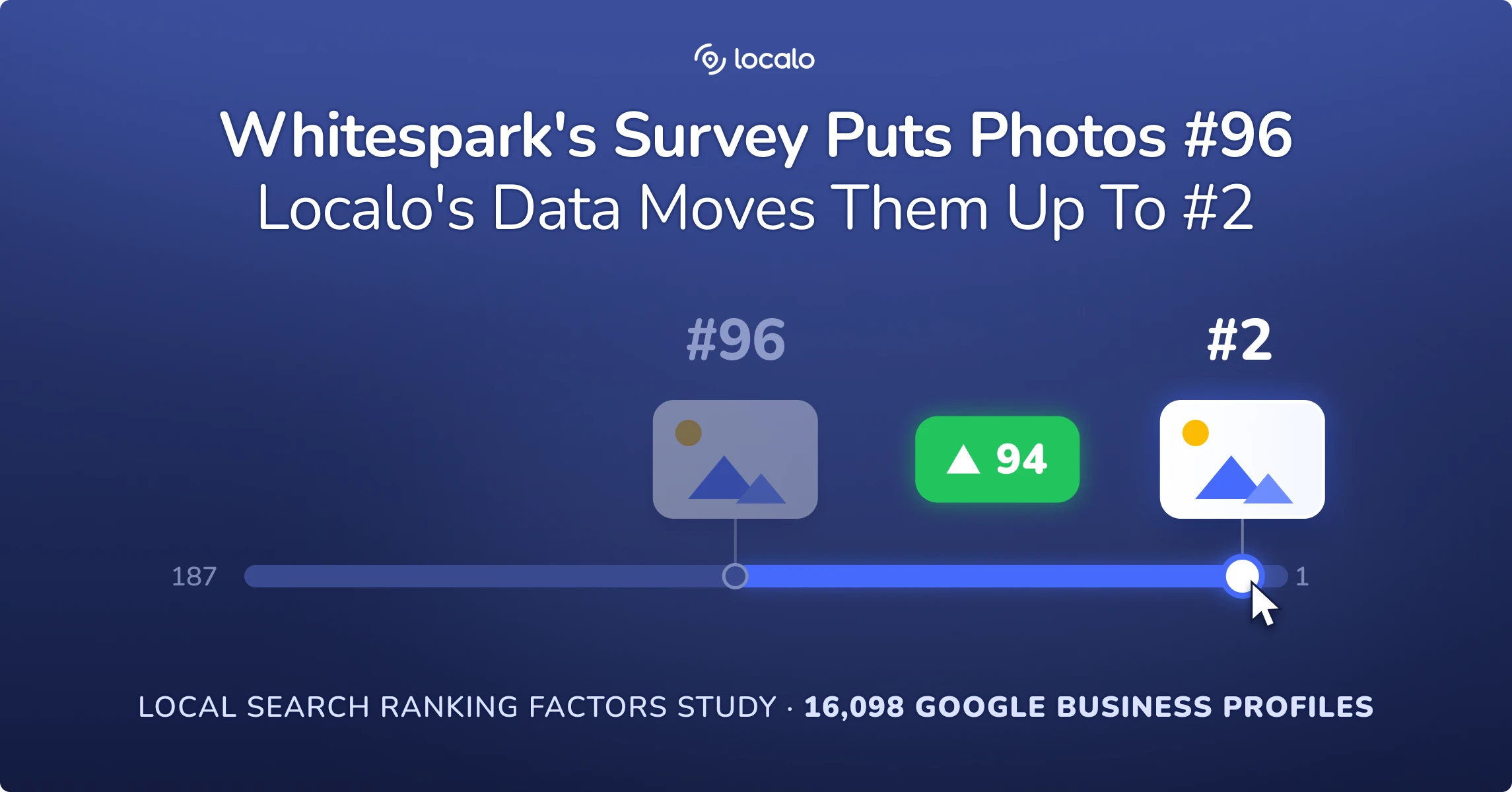
Whitespark’s survey results put photos at #96. Meanwhile, our data shows that uploading Google Business Profile photos is the 2nd strongest factor we measured, separating profiles by 25.4 points of top-3 rate. No other factor we tested moves this far on this large an effect.
Underrated: Social profiles are linked to GBP +20.3pp
Adding social media links to a GBP is a five-minute job worth +20.3pp of top-3 rate. Each platform can offer a different boost, but Facebook is the highest at +13.3pp, and YouTube is second best at +10.0pp. Meanwhile, experts placed this factor at #131 of Whitespark’s ranking.
Underrated: Quantity of structured citations (IYPs, data aggregators) +19.9pp
Investing into building local citations is worth the time and effort. Localo data shows that profiles with 21–50 citations rank top-3 19.9 points more often than profiles with 1–5, while Whitespark’s survey contributors placed it at #110. However, the effect plateaus at around 20 citations.
Underrated: Quantity of Google posts/updates +9.3pp
Profiles with 10+ active Google Business Profile posts rank top-3 73.0% of the time, against 63.7% for profiles publishing nothing, a 9.3-point spread. Getting to ten is the whole game. The pace makes no difference.
Underrated: Keywords in GBP description +4.6pp
Our analysis showed that stem-matched keywords in the profile description lift the top-3 rate by 4.6 points. Modest, and still the strongest keyword effect anywhere in this study.
💡 Here’s what experts missed:
Whitespark’s survey overlooks the value of GBP photos and social media links: profile photos should be ranked around #2 instead of #96, and social media should move to the top 10 instead of #131. These are the two largest disagreements between our study and Whitespark’s survey on factors that actually move rankings.
7 busted factors
Consensus says these seven move local rankings. Our data disagrees, and on two of them it points the other way:
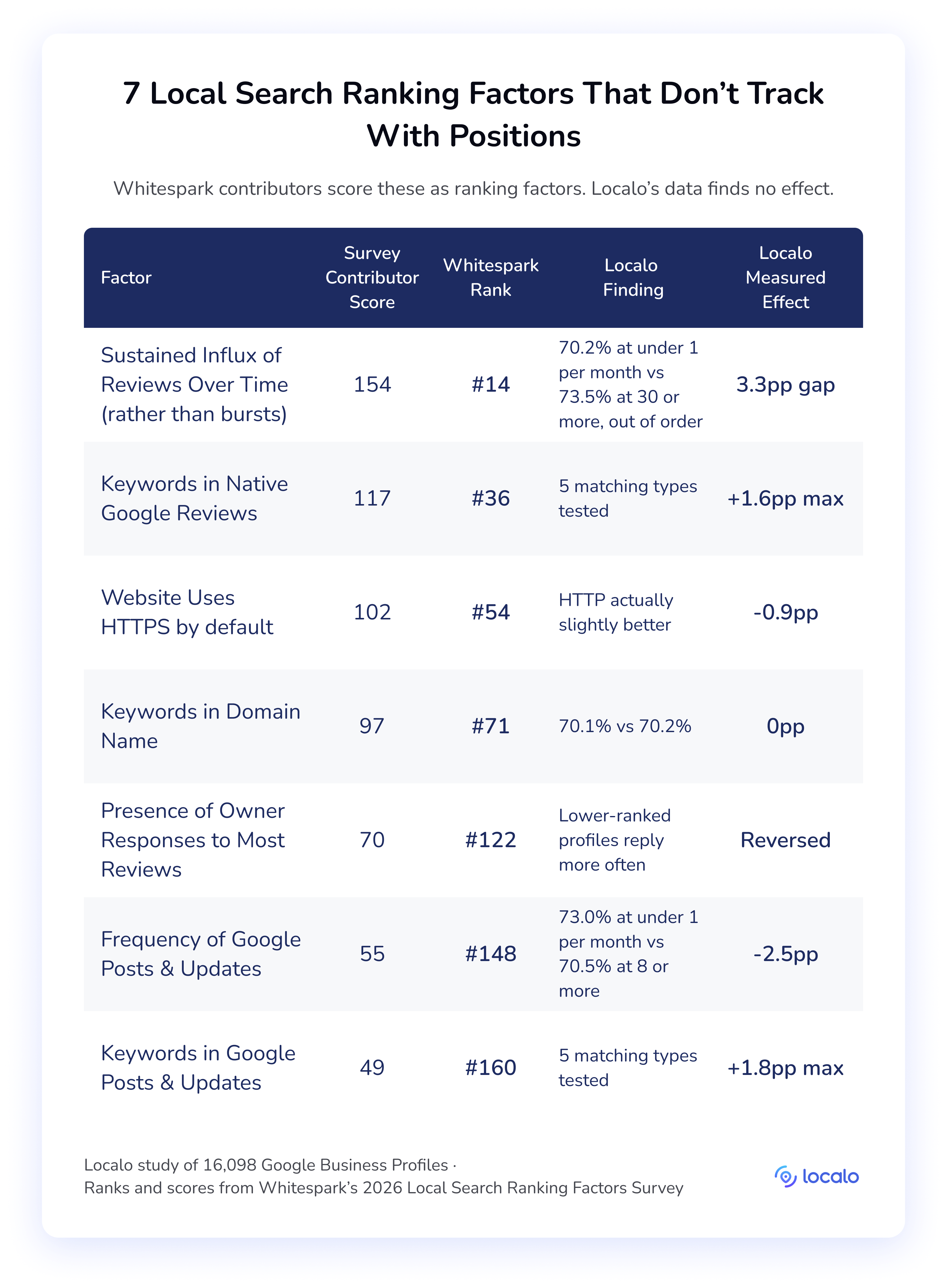
Busted: Sustained influx of reviews over time (rather than bursts)
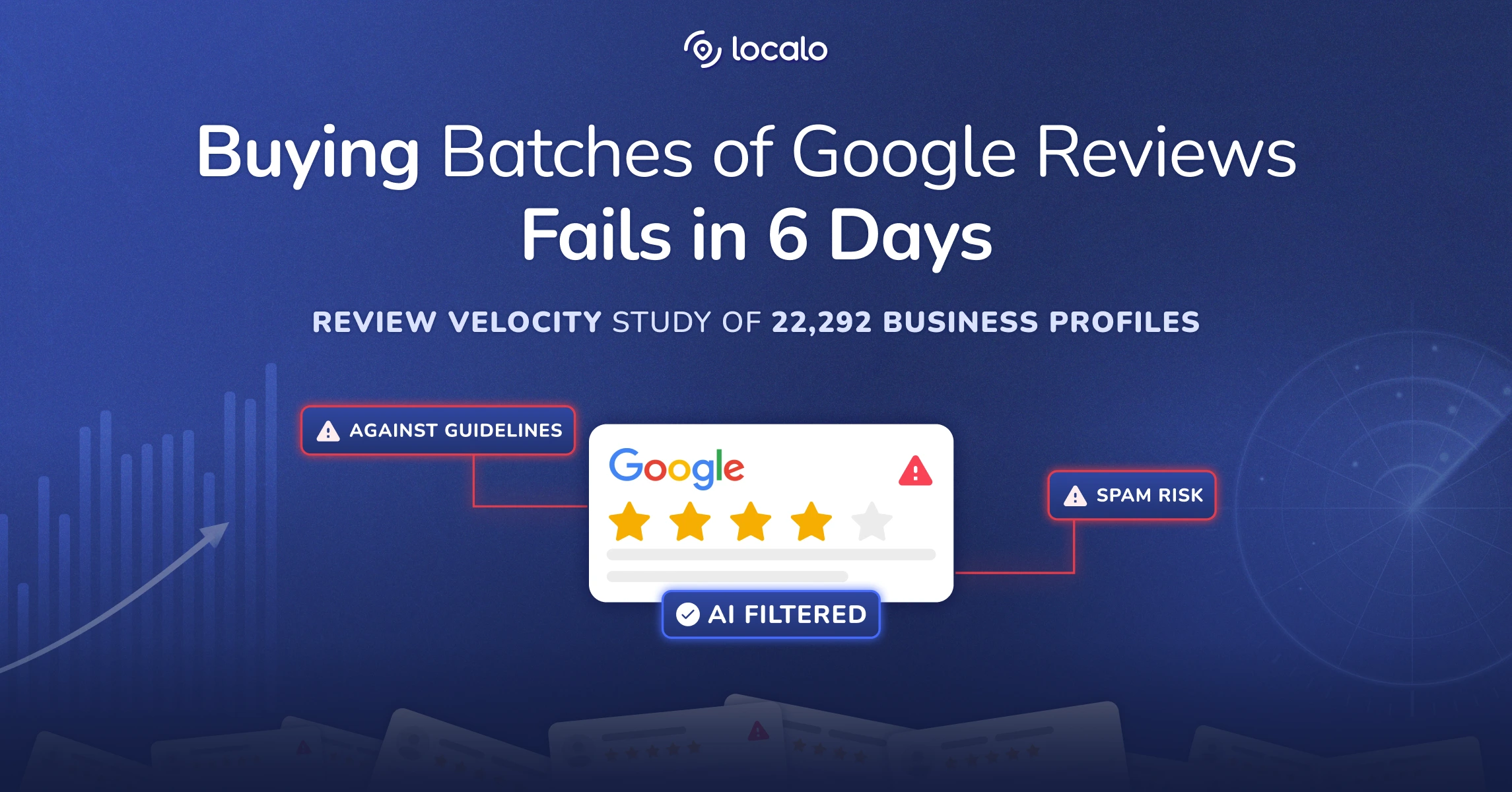
A steady drip of reviews is supposed to beat bursts. Profiles earning under one review a month rank top-3 70.2% of the time; at 30+ a month it’s 73.5%, with the brackets in between out of order. Best and worst sit 3.3 points apart. Pace does matter for a different reason: reviews arriving in bursts get deleted faster.
Busted: Keywords in native Google reviews +1.6pp max
Local keyword research is the foundation of local SEO, but are keywords necessary in customer reviews? We’ve tested that claim on our dataset using 5 matching methods: exact, broad, stem-4, stem-5, and any word. The maximum effect was +1.6pp for exact match, while most methods showed 0 or negative effects. Experts contributing to Whitespark’s survey placed keywords in reviews at #36 yet our data shows the effect is too small to act on.
Busted: Website uses HTTPS by default -0.9pp
Businesses with HTTP websites have a 70.9% top-3 rate compared to 70.0% for businesses using HTTPS, meaning that HTTP even wins a little. Sure, HTTPS matters for organic web search, but despite expert opinion it’s not a local pack ranking factor.
Busted: Keywords in domain name 0pp
The top-3 rate was nearly the same for businesses with keywords in domain name (70.1%) and businesses without keywords (70.2%). There’s simply no effect on local rankings.
Reversed: Presence of owner responses to most reviews
When we analyzed this factor, we saw a reversed pattern: the reply rate for top-3 positions was lower (73.4%) than for positions 11–20 (76.7%). That’s likely because businesses ranking below the top 10 put more effort in review management to improve the overall profile health.
Busted: Frequency of Google posts/updates −2.5pp
Posting several times a month does not beat posting rarely. Profiles publishing fewer than one post a month rank top-3 73.0% of the time; profiles publishing eight or more a month reach 70.5%. What moves the rate is the total: profiles with 10+ active posts reach 73.0%, against 66.0% at 1–9.
Busted: Keywords in Google posts/updates +1.8pp max
To analyze the impact of keywords in GBP posts, we tested 5 matching methods on 111,000+ posts. The maximum effect is tiny: just +1.8pp. Not worth spending much time on optimizing these posts.
💡 Here’s the biggest blind spot:
Experts’ belief in the impact of keywords is unsubstantiated, as keywords in reviews (#36) and posts (#160) are both busted. It shows that Google’s NLP algorithm has evolved beyond simple keyword matching. Meanwhile, owner responses (#122) show a reversed effect. Whitespark’s survey overestimates content-signal and review-behavior factors.
Expert views vs Localo data: Why so many differences?
One thing first: Whitespark’s survey gets the big things right. Reviews, profile completeness, and categories matter, and they matter a lot. The disagreements are in the details, and those details decide how agencies allocate optimization hours.
Too much emphasis on content signals
Experts rank keywords in the business title third in the entire survey, with a score of 223. Our data gives it +4.0pp. Across every field we tested, keyword placement tops out at +4.6pp for word stems in the description, falling to +1.8pp in posts and +1.6pp in reviews. Stem matching beats exact phrases in both fields where keywords register at all: +4.6pp against +2.3pp in descriptions, +4.0pp against +3.6pp in titles. Google reads these fields semantically.
Selling short visual and social signals
Photos (#96) and social media links (#131) are newer signals, and both score low. These factors require close collaboration with business owners and don’t fit the traditional SEO toolkit based on keyword research, content optimization, and link building. However, Google puts great value on such real-world signals, as they confirm business legitimacy and customer engagement.
Implied causation based on review behavior
The local SEO community believes that professional review management is rewarded by Google. Localo’s data, however, shows that replying to reviews, a steady review frequency, and including keywords in customer reviews don’t affect local rankings. The only factor that matters is the review volume.
Factors as possible qualifying thresholds
Some factors work as gates. Pass the threshold and you compete; go further past it and nothing more happens. Ratings behave this way: the top-3 rate steps up from 58.1% at 4.3–4.4 to 64.8% at 4.5–4.6, then adds only 4.3 points across the entire range up to 4.9. Any analysis built on ranked businesses understates factors like this, because the profiles that failed the gate are not in the sample.
💡 Here’s the root cause:
Whitespark’s survey is based on practitioners’ experience rather than data. Local SEO actions rarely focus on one element, so when an expert optimizes reviews together with keywords, photos, and GBP title, each activity gets credit, even if just one or two drove the impact. To separate the effect of each action, you need large-scale data analysis similar to what we’ve done for this study.
The 17 factors Localo tested are the ones a specialist can see and change inside a Google Business Profile. That is a useful slice, and it is a slice. Where we call a factor busted, we mean it produced no effect in profile-level data. We do not mean it does nothing anywhere in local search.
What Localo couldn’t test
The factors we left out are not a random sample. Some need data we do not hold. Others we hold in a form that answers a different question than the survey asks.
Factors that need data we don’t have
Most of the 170 untested factors sit outside the Google Business Profile: website analytics, link profiles, click behavior, page speed, domain authority. Localo tracks profiles, not the web around them. That single boundary accounts for the bulk of what is missing here, including every website and link factor in the survey.
Factors where our metric answers a different question
Citations are the clearest case. Whitespark scores them in at least nine ways. Four count them: locally relevant domains (#69), industry-relevant domains (#75), structured listings on IYPs and data aggregators (#110), and unstructured mentions in articles and blog posts (#115). Five more score consistency, from HTML NAP matching the profile (#15) through consistency across primary search engines (#28), key sites (#63), data aggregators (#85), and all other sources (#123).
Localo counts active directory listings, which maps to #110 and nothing else. Newspaper and blog mentions sit outside our crawl; we don’t tag directories by relevance, and we don’t check whether NAP data matches across them.
Review volume has the same shape in reverse. The survey scores reviews with text (#9, score 170) and ratings without text (#38, score 116) separately, 54 points apart. Our count does not distinguish them, so we test them together and cannot say whether that 54-point split is justified.
Data-corrected local ranking factors
Here’s the same set of factors re-ranked by measured effect. This does not replace the survey. It reorders the slice of it we could test.
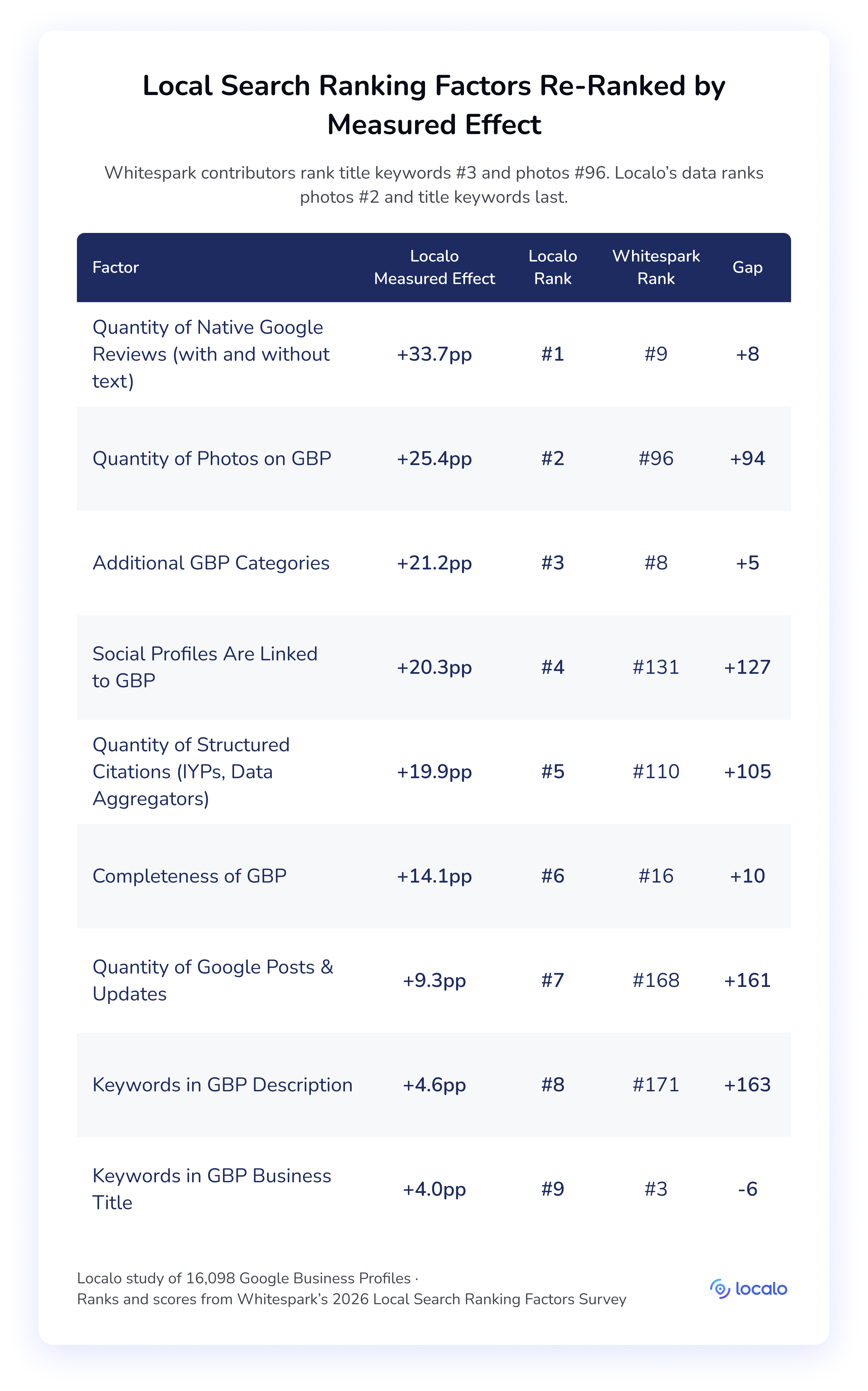
Key differences between Whitespark’s and Localo’s top 9 ranking:
- Photos jump 94 positions, as experts put them on #96 but our data moves them to #2
- Social media links move 127 spots upwards from #131 to #4
- GBP Posts go up by 161 positions from #168 to #7
- Title keywords drop from Whitespark’s #3 to our #9, the only factor in our top 9 that moved downward.
💡 Here’s the practical implication:
Following the expert ranking to a T will make you spend too much time on keyword optimization. Move those hours to photos, secondary categories, and social links: our #2, #3 and #4.
Methodology
This study cross-references the 2026 Whitespark Local Search Ranking Factors survey (187 factors scored by industry experts) against Localo’s dataset of 16,098 Google Business Profiles, 131,000+ tracked keywords, 111,000+ Google Posts, and 209,000+ customer reviews.
- We selected 17 factors from the 187-factor survey based on our ability to measure them from GBP profile data, excluding anything that needs website analytics, link profiles or behavioral data. Survey entries #9 and #38 both score review volume; our review count covers both, so they are tested as one factor.
- For each factor we calculated the percentage-point (pp) difference in top-3 ranking rate between businesses with the factor fully present and those without. Positive values indicate a ranking advantage.
- Verdicts read as follows. Confirmed means a clear positive effect consistent with the contributor ranking. Busted means zero or negative effect. Underrated means a strong effect where contributors rank the factor in the bottom half. Partial means the data supports the contributor view with caveats.
- All comparisons use observed frequencies and conditional probabilities across the full dataset, with effect sizes reported as percentage-point differences in top-3 rate.
- Correlation does not equal causation. Factors we could not test may mediate or moderate the effects we observed, and results reflect 2026 data that may change as Google’s algorithm evolves.
Frequently asked questions
Why can’t you test all 187 factors rated by Whitespark?
Most need data we do not hold: website analytics, link profiles, click behavior, page speed, domain authority. We tested the 17 factors measurable directly from profile, review, citation and post data. The other 170 sit outside our dataset.
Is Whitespark’s survey wrong?
No. Contributors correctly identified review count (#9), secondary categories (#8) and profile completeness (#16). Of the 17 factors we tested, 7 were busted and the rest confirmed or underrated. The survey holds on structural factors and misses on content signals.
Why do SEO experts overrate the impact of keywords on local performance?
Keyword optimization has been core to SEO for 20+ years, and industry opinion still matches an older, more literal Google. Modern NLP reads business relevance from categories, photos and reviews, without needing exact matches in every text field.
Why are experts wrong on the effect of profile photos?
Photos are a newer signal, and they sit outside the text-based work practitioners control directly. They need real images from the client, which no keyword framework covers. Our data puts them second, at +25.4pp, against a contributor rank of #96.
Should GBP owners stop responding to reviews if that doesn’t improve ranking?
No. Replies do not track with local rankings in our data, but they build customer trust and support conversions. Keep replying for the reputation return, and budget the time against that outcome rather than against position.