

Google killed the no-text review loophole. If you manage Google Business Profiles, you’ve probably heard that rating-only reviews are safer: that Google can’t remove what it can’t read. Localo’s dataset of 335,520 deleted reviews from 22,292 profiles seems to back that up: reviews with text disappear 2–3 times faster than no-text ones.
But that gap is an artifact of age. Control for the year a review was created and it collapses to 0–10%. In 2025, text reviews lasted a median of 13 days versus 14 for no-text. And among the 5,804 profiles with more than 10 deleted reviews, the pattern flips: on profiles pulling 50+ reviews a week, no-text reviews are removed in a median of 6 days versus 14 for text.
The data points to a structural reason: Google runs a multi-layered moderation pipeline where text reviews go through NLP analysis, while no-text reviews are judged on velocity and account patterns. On high-velocity profiles, that makes rating-only reviews the first to be batch-deleted, even though they outlast text reviews everywhere else.
This study breaks down how each layer decides what to remove, and closes with six rules for gathering authentic Google reviews that survive Google’s detection instead of vanishing weeks after you earn them.
At first glance, text reviews get removed 2–3x faster
Localo’s data shows that reviews with text get deleted much faster than the ones without it. That’s because Google’s algorithms use natural-language processing to analyze user comments to detect spam and fake or misleading content. This effect is most pronounced for 1- and 2-star reviews (3.4–3.5×), and remains strong for high-volume 5-star reviews (2.3×).
| Star rating | With text (median) | No text (median) | Multiplier |
|---|---|---|---|
| 1-star | 22 days | 75 days | 3.4x |
| 2-star | 237 days | 837 days | 3.5x |
| 3-star | 440 days | 1,142 days | 2.6x |
| 4-star | 403 days | 771 days | 1.9x |
| 5-star | 56 days | 127 days | 2.3x |
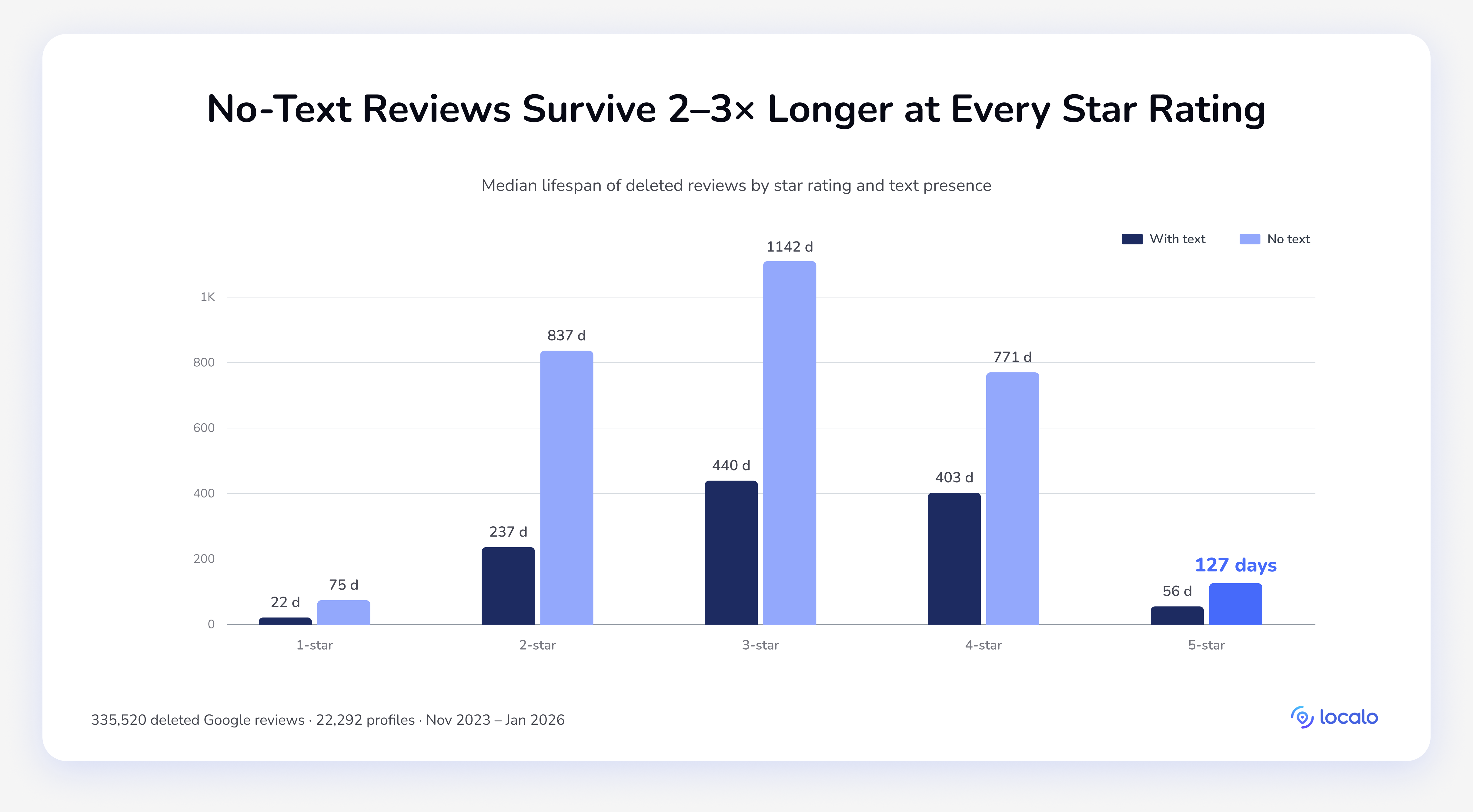
🔎 Key takeaway: Data collected over the years shows that reviews without text survive on Google profiles 2–3x longer on average.
💡 Tip: Google deletes user content that sounds fake or incentivized to discourage black hat SEO practices such as buying reviews. Explain to clients that getting authentic reviews at a steady pace is better for their business.


Text vs. no-text gap vanishes when controlling for review age
Here’s a twist: the no-text reviews that lasted a long time come from 2020–2022. They survived for years before Google removed them. Text reviews that get caught quickly are from 2024–2025. When we’ve controlled our data for creation year, the text vs no-text difference was insignificant.
| Year created | Median lifespan of text reviews | Median lifespan of no-text reviews | Ratio |
|---|---|---|---|
| 2020 | 1,821 days | 1,890 days | 1x |
| 2021 | 1,477 days | 1,528 days | 1x |
| 2022 | 1,031 days | 1,161 days | 1.1x |
| 2023 | 700 days | 790 days | 1.1x |
| 2024 | 326 days | 367 days | 1.1x |
| 2025 | 13 days | 14 days | 1.1x |
| 2026 (January) | 5 days | 5 days | 1x |
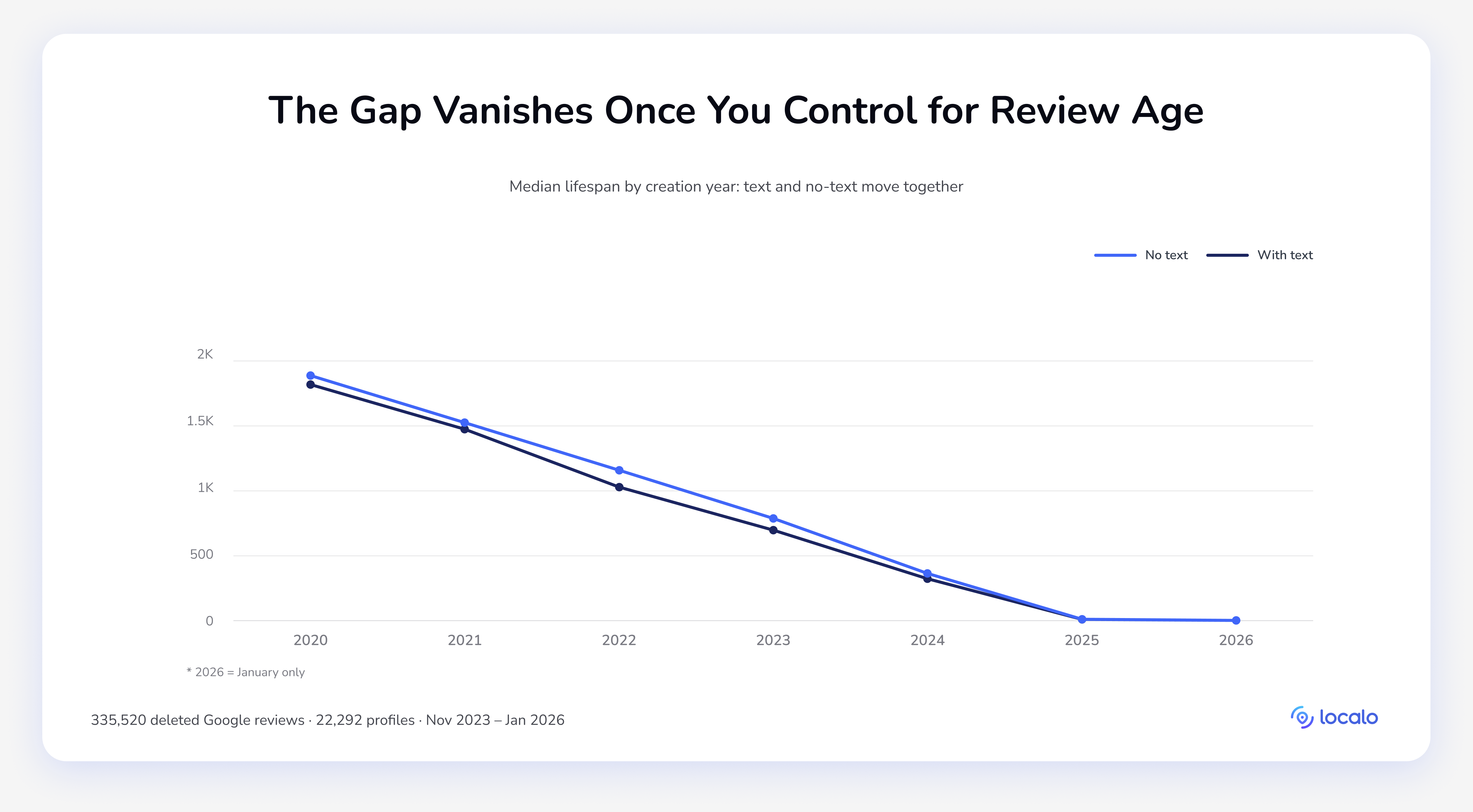
🔎 Key takeaway: Google’s pace of fake review detection depends on the review’s age and velocity, not on including text. The text vs no-text gap is just a statistical illusion caused by the age distribution of analyzed reviews.
💡 Tip: In 2025–2026, Google’s algorithms became equally efficient at catching all types of fake reviews. Improve GBP ratings through authentic customer reviews coming at a natural pace rather than fake no-text reviews.
High velocity makes no-text reviews disappear fast
Here’s another twist: when we’ve taken into account review velocity, meaning the maximum reviews per week for each profile, the results change dramatically. When analysing the 5,804 profiles with more than 10 deleted reviews (enough removals to measure velocity reliably):
- no-text advantage peaked at mid-velocity (11–50 reviews per week) with no-text reviews lasting 5.3 times longer than text ones
- …then it reversed at extreme velocity (50+ reviews per week): no-text reviews were removed faster, lasting only 0.4× as long as text reviews (6 days vs 14)!
| Velocity | Median lifespan of text reviews | Median lifespan of no-text reviews | Multiplier |
|---|---|---|---|
| 1–3 / week | 321 days | 641 days | 2x longer |
| 4–10 / week | 94 days | 259 days | 2.8x longer |
| 11–50 / week | 40 days | 211 days | 5.3x longer |
| 50+ / week | 14 days | 6 days | 0.4x (REVERSED!) |
This 6-day figure is the median for no-text reviews on 50+/week profiles. In our review velocity study, “6 days” refers to the overall median on 100+/week profiles: the same dataset, measured a different way.
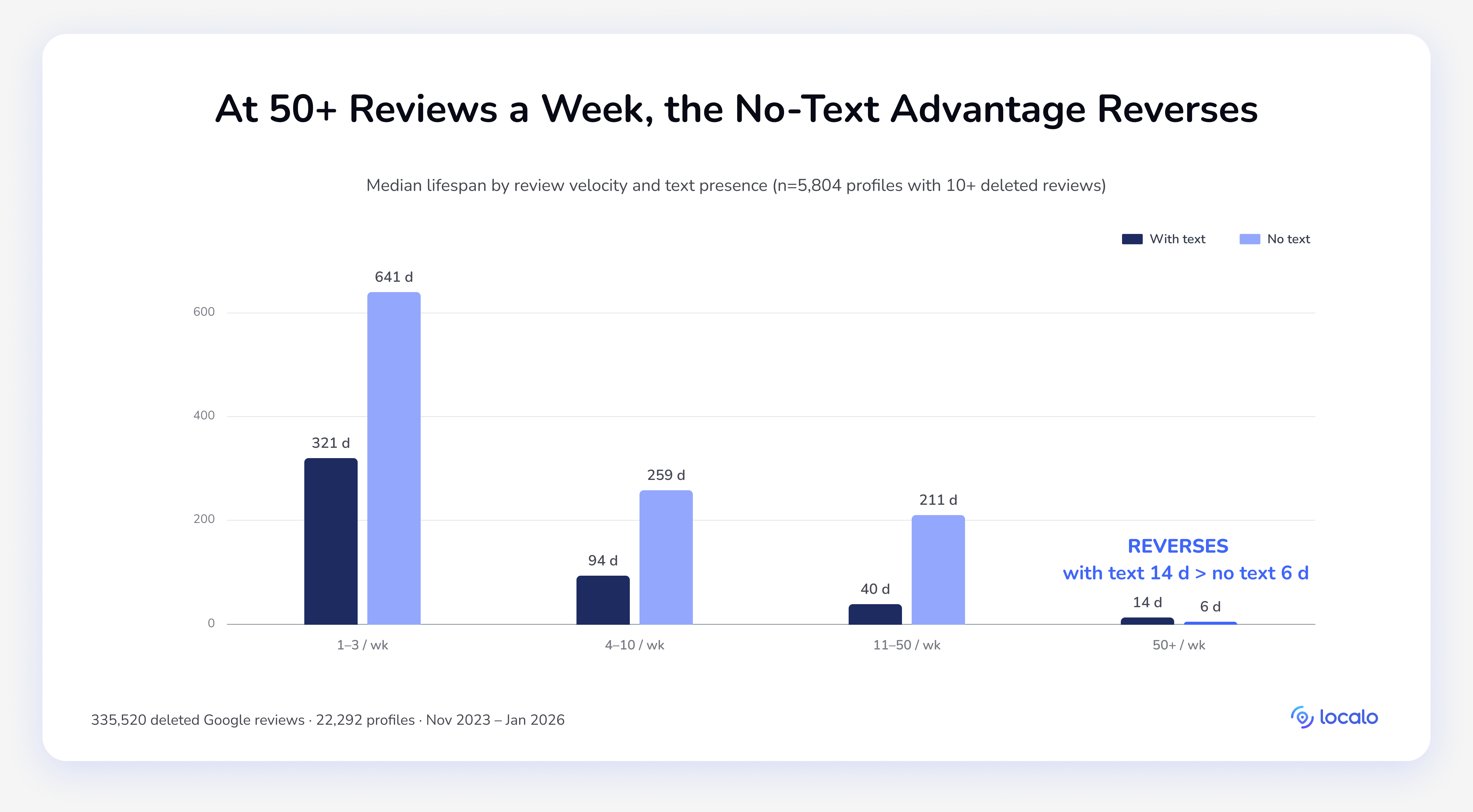
🔎 Key takeaway: The no-text advantage exists only on low to medium-velocity profiles. GBPs getting reviews at extreme velocity get on the radar of Google’s pattern-based detection that monitors suspicious account behavior. When that happens, no-text reviews are an easy target because they’re commonly posted by review farms.
💡 Tip: If you spot multiple no-text reviews posted on a Google Business Profile at an unnatural pace, report them to Google immediately.
Google’s algorithms understand natural language
We've analyzed the contents of deleted reviews to check what type of content survives the longest. They come down to four categories:
- clean text in user’s own language
- generic phrases, e.g., “highly recommend”, “excellent service”, etc.
- translated and containing “Translated by Google”
- no text
What surprised us is that clean, original text reviews get deleted the fastest. That means Google’s algorithms are fully capable of detecting fake reviews that mimic natural language. It’s also likely that NLP detection is additionally confirmed by suspicious account behavior patterns.
Keep in mind this analysis covers only reviews Google removed. Genuine, detailed reviews from real customers aren’t the target here. The takeaway is that Google can unmask fakes even when they read naturally.
| Review type | Number of reviews | Median lifespan | Removed within 7 days | Removed within 30 days |
|---|---|---|---|---|
| No text | 55,663 | 127 days | 27.6% | 38.8% |
| Translated by Google | 82,467 | 79 days | 24.9% | 40.7% |
| Generic phrases | 50,391 | 58 days | 29.4% | 44.7% |
| Clean, original text | 110,312 | 40 days | 32.7% | 48.2% |
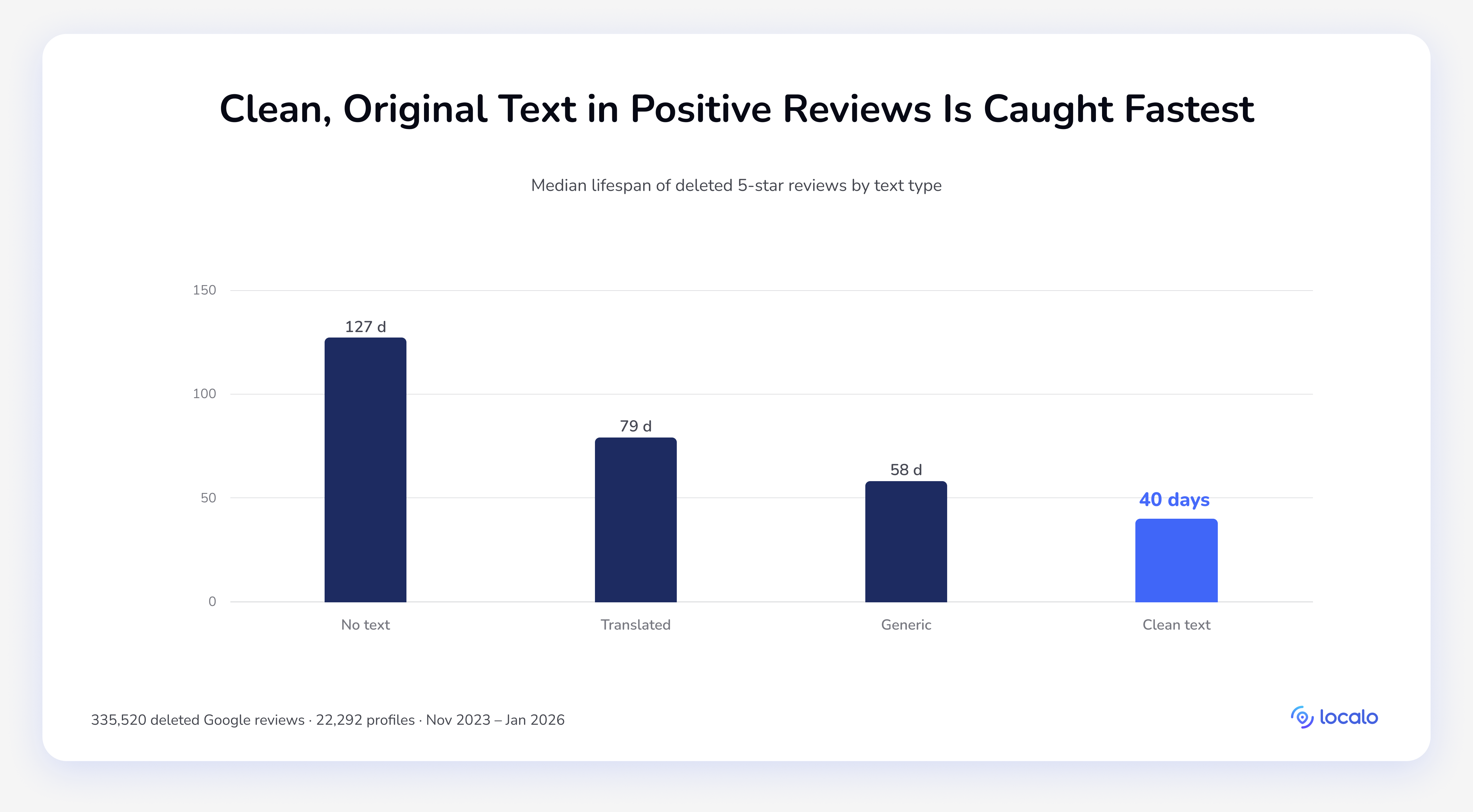
🔎 Key takeaway: Translated reviews survive the longest among reviews with text, possibly because Google’s algorithms work best on original language text.
💡 Tip: Don’t assume that well-written fake reviews are safe from deletion. Schedule routine checks to monitor deleted Google reviews and assess the impact of review removal on the profile rating.
Once a review has text, its length doesn’t matter
The median lifespan of text reviews is 53–60 days no matter if they contain just one word or a hundred. In contrast, no-text reviews have a median lifespan of 127 days. This suggests that Google’s algorithm first checks if the review has text, and afterwards sends it to a faster detection pipeline.
| Text length | Reviews | Median lifespan |
|---|---|---|
| No text | 55,663 | 127 days |
| 1–5 words | 27,946 | 53 days |
| 6–10 words | 29,031 | 60 days |
| 11–20 words | 50,177 | 58 days |
| 21–50 words | 85,253 | 54 days |
| 51+ words | 50,763 | 59 days |
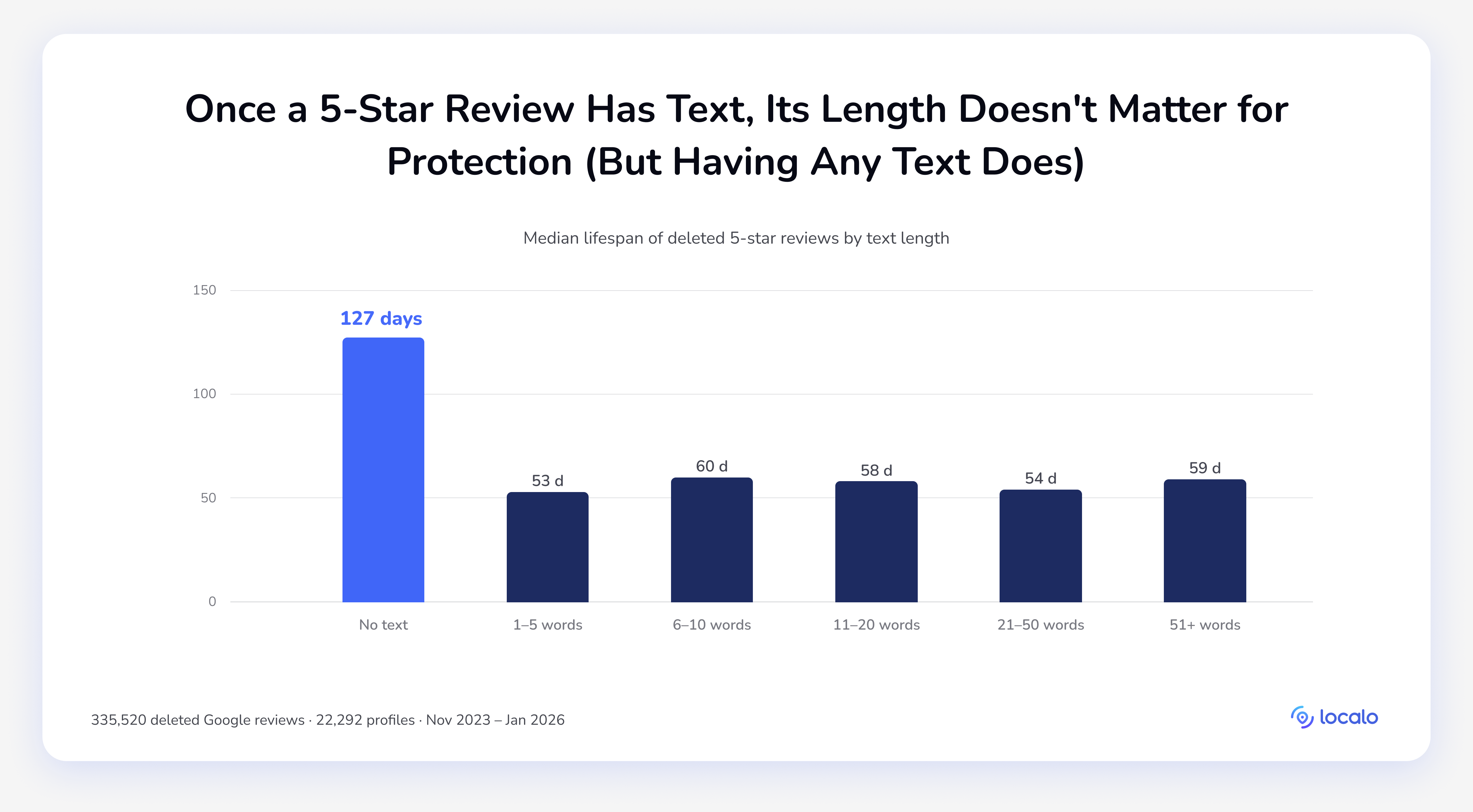
🔎 Key takeaway: Including text in a review triggers NLP detection algorithms designed to spot fake or misleading content.
💡 Tip: No-text reviews survive longer, but it doesn’t mean that business owners should tell clients to avoid writing comments. Getting genuine reviews at a natural pace helps to build a positive business image and encourage Maps users to visit the place.
Negative reviews with text are 3.4x more suspicious for Google
The text vs star-only review difference is stark for negative ratings. 1-star reviews with generic phrases, e.g. “terrible service”, are gone within 12 days while the ones without text survive 75 days on average.
| 1-star review type | Reviews | Median lifespan |
|---|---|---|
| No text | 2,961 | 75 days |
| With text (clean) | 15,917 | 23 days |
| With text (generic phrases) | 822 | 12 days |
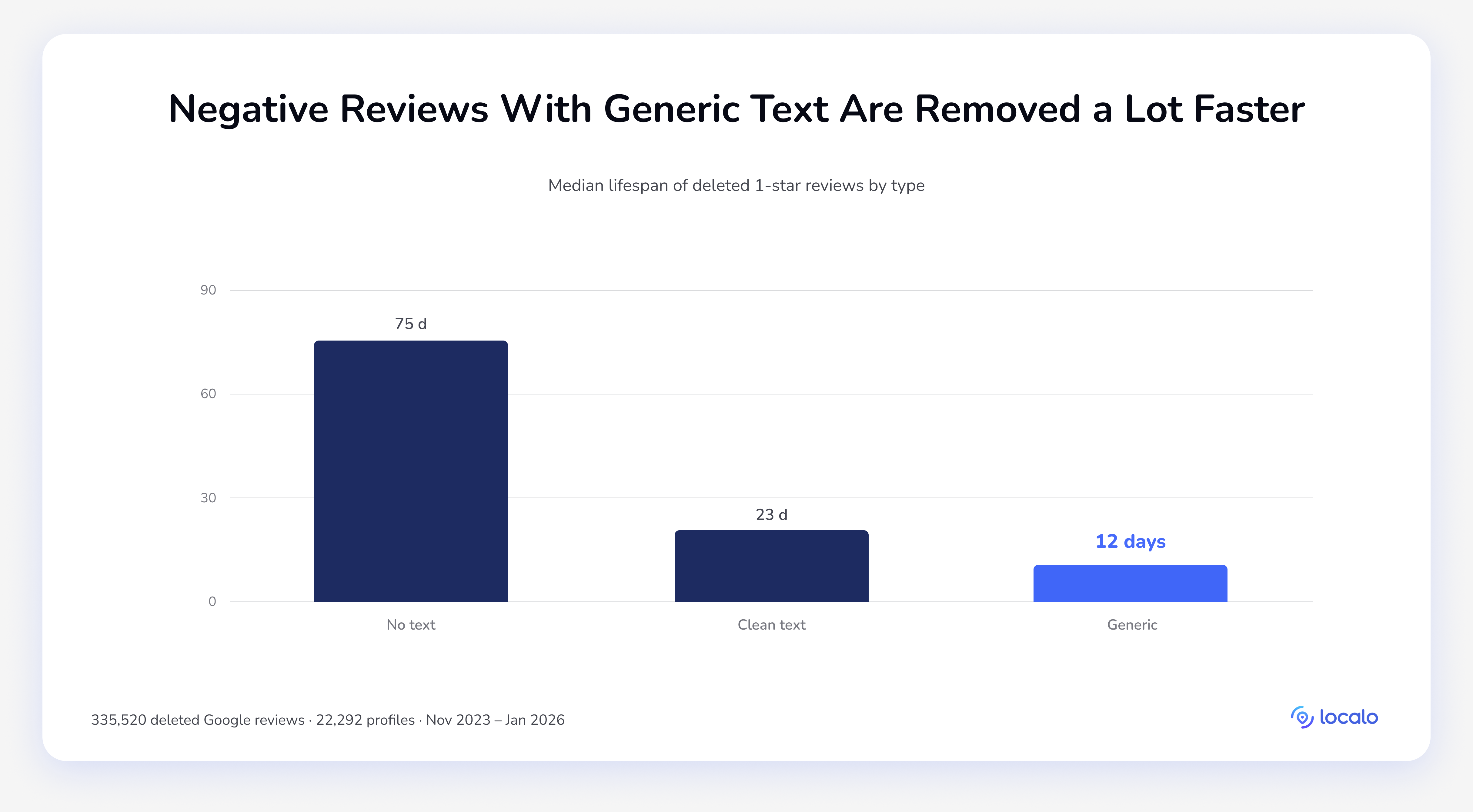
🔎 Key takeaway: Google is highly effective at spotting fake template-based negative review attacks. No-text 1-star reviews last 6x longer on GBPs than generic 1-star reviews.
💡 Tip: If you spot a sudden flow of generic-text negative reviews, report them and don’t panic. Google will likely remove them quickly. Additionally, respond to reviews with personalized, non-template replies, even if they’re negative. Profile visitors value such professionalism.
Google’s review moderation pipeline has multiple layers
After analyzing Localo’s data, we conclude that Google’s review moderation system has the following structure:
Layer 1: Velocity detection
- Rapid process taking days
- Reviews on profiles receiving 50+ reviews/week get flagged ASAP
- No text analysis needed, batch deletion happens within days
Layer 2: Text/NLP analysis
- Fast process taking weeks
- Reviews containing text enter the natural-language processing pipeline; no-text reviews move to Layer 3 automatically
- Looks for generic phrases, translated content, suspicious patterns
- Algorithm analyses clean text for authenticity signals, e.g., account age, review history, etc.
Layer 3: Pattern/Metadata analysis
- Slow process taking months
- Metadata analysis of no-text reviews and reviews that passed Layer 2
- Monitoring account behavior, geographic patterns, device fingerprints, timing
Layer 4: Retroactive sweeps
- Periodic process taking years
- Google re-evaluates old reviews using improved algorithms
- Reviews from 2017–2020 still get deleted
🔎 Key takeaway: The text vs. no-text gap exists because these types of reviews enter different detection layers with varying processing speed. As Google continuously improves detection algorithms, all processes become faster. In 2025–2026, text and rating-only reviews have nearly identical detection pace.
💡 Tip: If you learn that your client had paid for reviews in the past, be prepared for their removal as part of your review management process. Localo's Reviews manager can help you display customer ratings from all GBPs you manage in a single dashboard.
Key takeaways for local SEO specialists
The no-text loophole is closed. Here’s how to build reviews that actually last on your clients’ profiles:
- Don’t treat rating-only reviews as a shortcut. In 2025–2026, Google catches no-text reviews about as fast as text ones, so the “safety” is gone.
- Manage pace, not text. Sudden spikes in review velocity, not whether a review has text, are what trigger fast, batch removals. Keep review growth natural.
- Authentic, specific reviews from real customers are the durable kind. Google removes natural-sounding fakes fastest, but genuine detail from real accounts isn’t what these deletion patterns target.
- Don’t engineer a perfect 5.0 or lean on template phrases like “highly recommend”; both are removal markers.
- Monitor removals on a schedule. Retroactive sweeps mean even years-old fake reviews eventually go, so check for deleted reviews regularly rather than assuming posted reviews are safe.
- Report unnatural bursts. A sudden flow of rating-only reviews or template negative reviews can be reported, and Google typically clears template attacks within about two weeks.
This week, pick one client profile and run a review audit in Localo: check which reviews Google has already removed, then compare those removal dates against your last review-request campaign. If a spike in new reviews lines up with a batch removal, you’ve found the velocity pattern to fix before it spreads across the rest of your portfolio.
Methodology
This analysis is based on 335,520 deleted Google reviews from 22,292 business profiles, tracked by Localo between November 2023 and January 2026. February and March 2026 were excluded due to incomplete data. Text presence was determined by the “comment” field. “Translated by Google” was detected via string matching. Generic phrases were identified using a list of 12 common review templates. Velocity was measured as maximum reviews within any 7-day rolling window per profile. Only profiles with more than 10 deleted reviews were used for velocity analysis (n=5,804). All findings describe patterns in removed reviews only. They characterize what deleted content looks like, not the full population of Google reviews.
Metric definitions used in this analysis:
- Median lifespan is the number of days between a review’s creation date and its removal date.
- Max reviews/week (velocity) is the highest number of new reviews on a profile within any 7-day rolling window across the measurement period.
- Removed within 7 / 30 days is the share of a group’s deleted reviews that Google removed within 7 or 30 days of posting.
- Multiplier is how many times longer no-text reviews survived than text reviews; a value below 1 means no-text reviews were removed faster.
- Lifespan by year created groups deleted reviews by the year they were originally posted, not the year they were removed.
Sources
- Google Business Profile Help, “Report inappropriate reviews on your Business Profile.” support.google.com/business/answer/4596773
- Maps User Generated Content Policy Help, “Prohibited & restricted content.” support.google.com/contributionpolicy/answer/7400114