
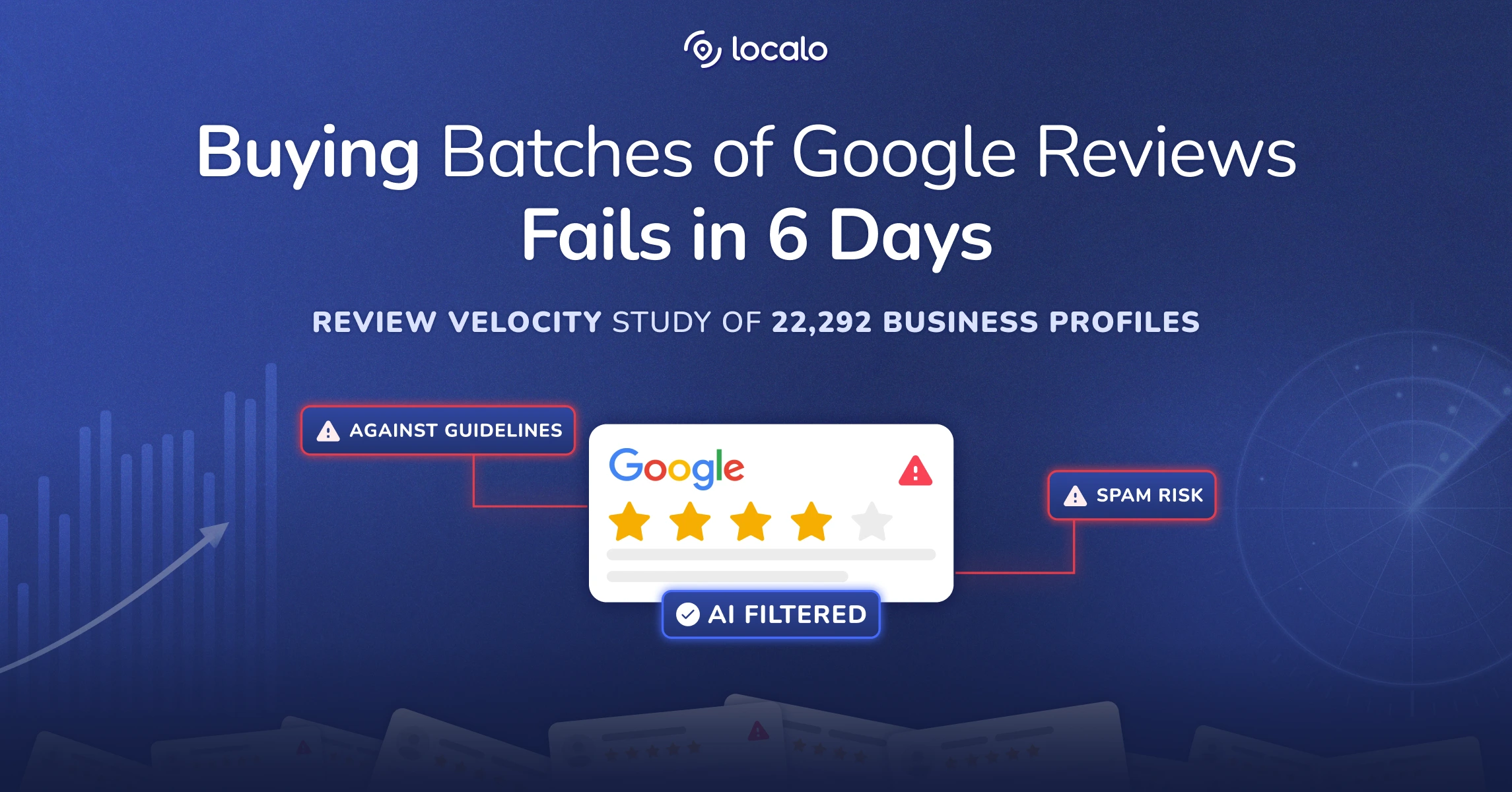
Buying Google reviews is the fastest way to lose them. Localo studied 335,520 deleted reviews from 22,292 Google Business Profiles between November 2023 and January 2026 to map how Google detects and removes fake reviews, and what business owners and agencies should do instead.
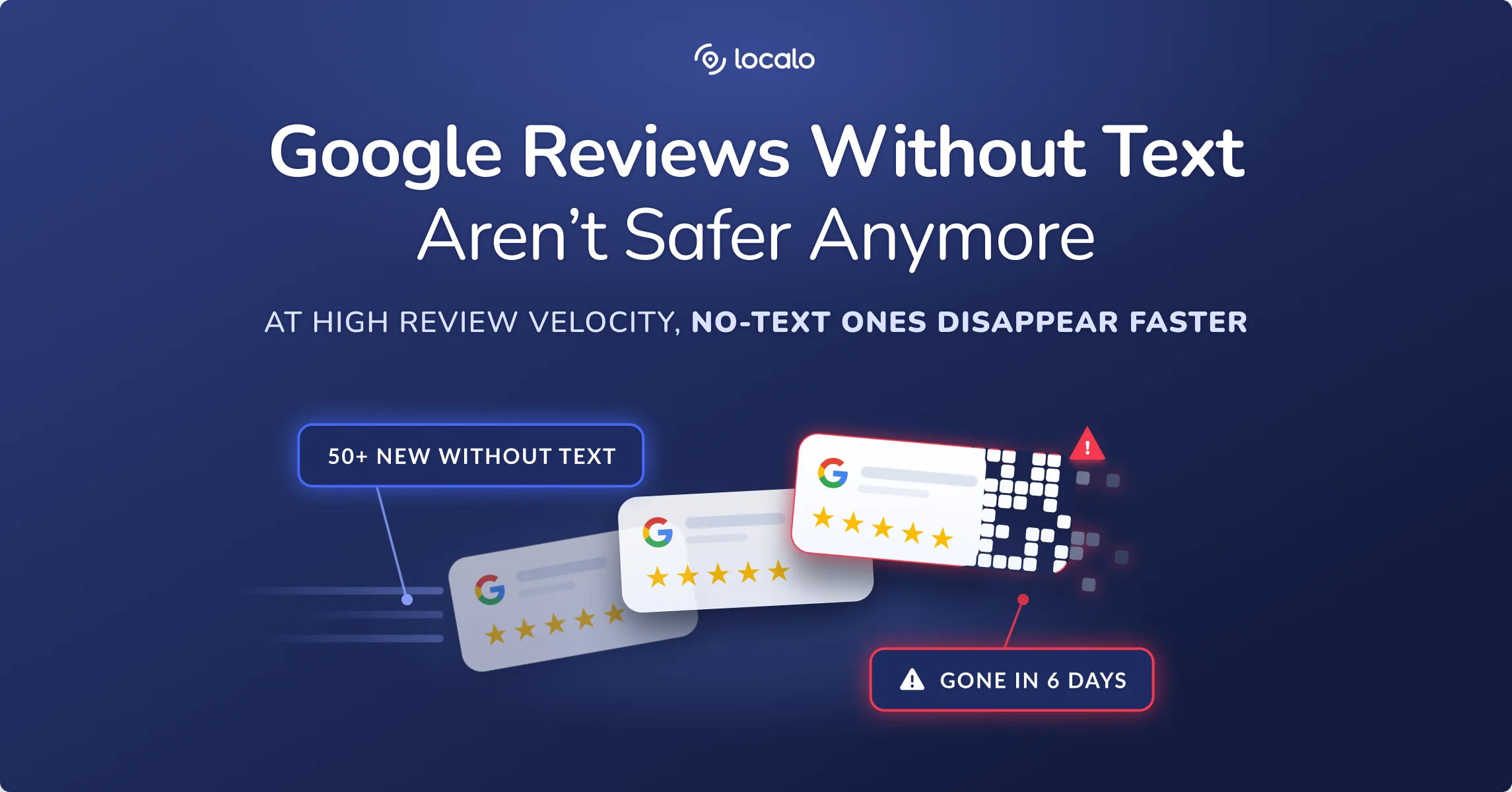
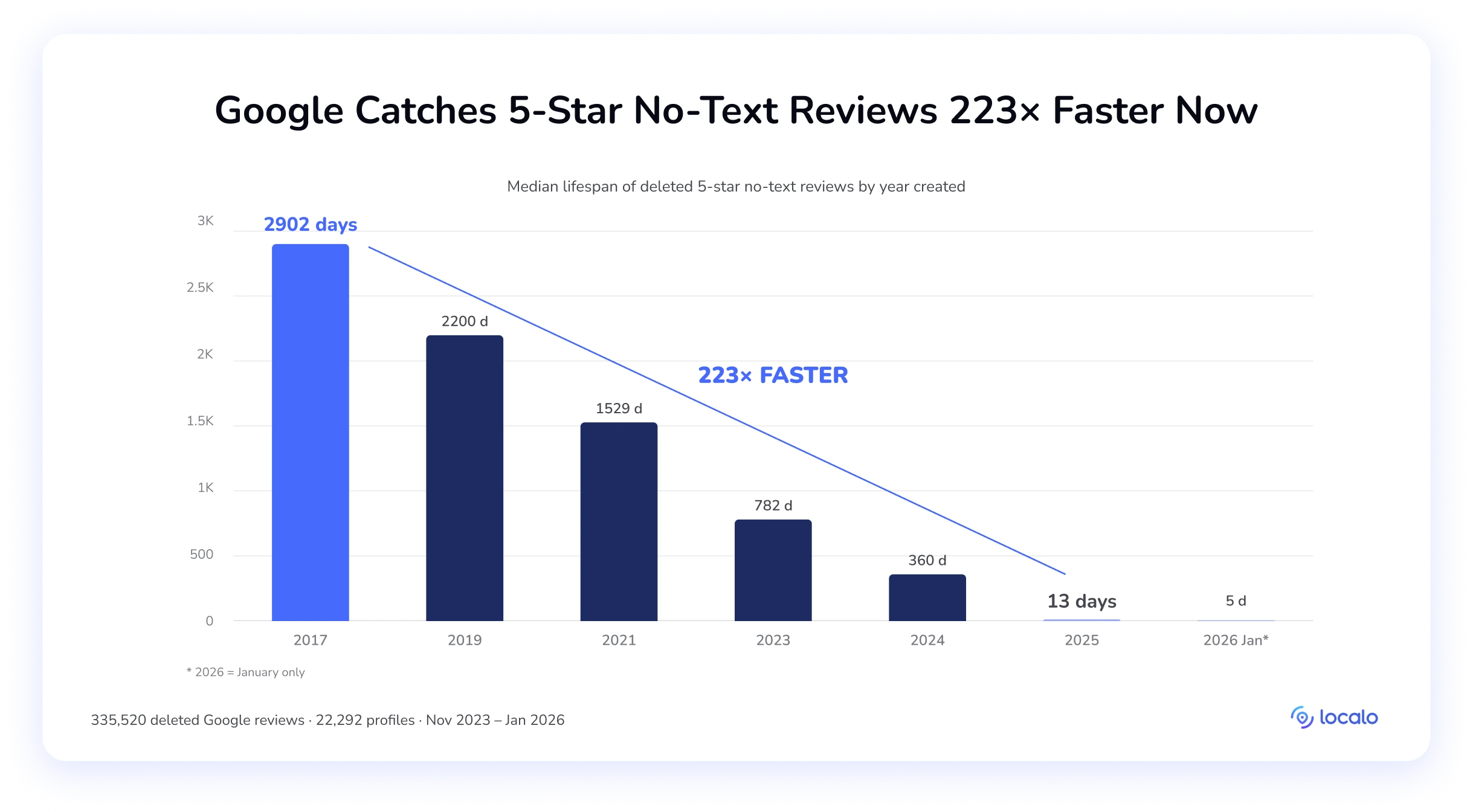
One signal dominates the deletion patterns: review velocity. Profiles getting 100+ new reviews a week lose them in 6 days, 99x faster than profiles growing organically. Reviews containing generic text vanish 2.3x faster than rating-only reviews at the 5-star level and up to 3.5x faster across other star ratings. Google’s deletion volume has grown 15x since late 2023, and its detection speed has accelerated even faster. Median lifespan for the hardest-to-detect cohort (5-star, no text) dropped from 2,902 days for reviews published in 2017 to just 13 days for reviews published in 2025.
The rest of this study covers four areas: legal exposure to fines under U.S., German, French, and Polish law; the four detection factors algorithms use to flag fake content; how to calculate a profile risk score from velocity, 5-star concentration, and generic-phrase density; and five organic alternatives for growing GBP ratings to a healthy 4.2-4.7 range.
Should You Buy Google Reviews? Data Answers
No. Buying fake Google reviews violates Google’s user-generated content guidelines and can result in a Google Business Profile suspension. The platform now removes fake reviews from high-velocity profiles within days, sometimes within a single week of posting, and within hours when batch deletions hit.
Here are four reasons why buying Google reviews is a bad idea:
- Bought or incentivized reviews are included in the prohibited Fake & Misleading Content & Reviews category.
- Google’s algorithms flag patterns in user behavior, content, and owner practices such as review gating.
- Batch deletions can crater GBP’s rating and even lead to profile suspension or deletion.
- Fake positive reviews are obvious to customers, which damages reputation faster than no reviews at all.
Worst-case scenario, you’re also risking legal penalties. In 2026, fines for deceptive marketing reach $53,088 per violation in the U.S., 4% of annual turnover in Germany, €300,000 plus 2-year prison sentences in France, and 10% of annual revenue in Poland.
The next section covers Google policies, review gating, Google’s activity regarding review policy violations, and country-specific legislation in more detail.


What Are the Penalties for Detected Bought Reviews (Google Policy and Country Laws)
What Google Review Policy Says
Google’s guidelines state that user-generated content must contribute to the overall positive experience of using Maps while being truthful:
“We work hard to make sure content published by our users is helpful and reflects the real world.”
More details about reviews appear in the prohibited & restricted content section:
“Contributions to Google Maps should reflect a genuine experience at a place or business, and a review or rating should reflect an actual experience with a business, and be genuine and unbiased.”
Additionally, fake engagement and rating manipulation are prohibited behaviors. Content that isn’t allowed includes inaccurate descriptions of the location or product, paid reviews, content posted from multiple accounts by a single individual, reviews biased by a conflict of interest, and content designed to manipulate the rating. Business owners can’t:
“Offer incentives - such as payment, discounts, free goods and/or services - in exchange for posting any review or revision or removal of a negative review.”
Other unwanted behaviors include prohibiting or discouraging negative reviews and pressuring users to leave reviews while still on the premises.
What Review Gating Is and Why It’s Banned by Google
Review gating is screening customers’ opinions before publishing them. For example, each customer gets asked about their experience. Satisfied customers get a link to leave a review on Maps; unsatisfied clients get a link to a private feedback form or a customer service page. This way, only happy customers leave public reviews.
Businesses are prohibited from review gating on Google since April 12, 2018, as owners are not allowed to:
“Discourage or prohibit negative reviews, or selectively solicit positive reviews from customers.”
This practice affects the whole Business Profile and its star rating. When Google detects review-gating behavior, it can penalize the business in various ways, including batch review removals or even suspending the entire profile.
Mike Blumenthal’s study for GatherUp showed that dropping gating practices can increase the number of reviews by 68% without significantly impacting the star rating.
In the U.S., the business might also get fined by the FTC, which also prohibits review suppression, and the penalty can be steep. In 2022, the FTC issued Fashion Nova with a $4.2 million fine for showing only positive reviews on brand pages, as BrightLocal recalls.
What Does It Cost a Google Business Profile That Violates the Policy
Reviews that violate Google policies aren’t rare. In 2025, Google blocked or deleted 292 million reviews while having published over 1 billion reviews. That means around 22% of submitted review content gets flagged as fake or misleading.
Google’s response to detecting prohibited content depends on the scale of the violation: when it’s just a handful of spam or fake reviews, those reviews are deleted. However, if Google moderators suspect fraudulent behavior, actions can get more severe. SterlingSky’s case study describes a business that experienced a batch deletion of 700+ reviews removed in less than a month.
Another common penalty is turning off reviews on the affected profile for 30 days. The profile may display a warning banner informing customers that fake reviews have been deleted, and existing reviews may be unpublished for a set period. In 2025, Google imposed posting restrictions on 782,000 accounts for violating its fake engagement policy.
When Google decides these measures aren’t enough, they can suspend the profile or even delete it altogether. In 2025, 13 million fake Google Business Profiles were removed from Maps. As this is a last-resort solution, profile deletions usually happen when the profile listing is misleading; however, repeated content policy violations could also trigger suspension. While it is possible to appeal Google’s decision if you believe the restrictions are unsubstantiated, it will likely take some time.
Consequences of fake reviews aren’t limited to business owners, as users who post misleading reviews or spam can have their accounts suspended or banned, too.
What Is the Legal Exposure Country by Country
As of 2026, businesses engaging in deceptive marketing practices, such as buying fake Google reviews, can be fined in several countries, including the U.S., Poland, Germany, and France.
| Country | Legal framework | Prohibited behavior | Maximum penalty |
|---|---|---|---|
| The U.S. | FTC ruling on the Use of Consumer Reviews and Testimonials: FTC 16 CFR Part 465 effective Oct 21, 2024 | paid reviews reviews created by undisclosed insiders review suppression AI misrepresentation in reviews | up to $53,088 per violation |
| Germany | Gesetz gegen den unlauteren Wettbewerb reformed on 28 May, 2022, § 3 + Anhang Nr. 23b/23c | purchasing and selling reviews fake positive or negative reviews deleting legitimate reviews intimidating authors of honest reviews | up to 4% annual turnover or €2,000,000 |
| France | Code de la consommation Articles L.132-2, L.121-1, 121-4 | publishing fake reviews not disclosing incentivized reviews deleting or hiding negative reviews | €300,000 + 2-year sentences |
| Poland | UOKiK + EU Omnibus directive (2019/2161) | buying or selling fake reviews review gating incentivizing reviews pressuring customers or staff to write positive reviews | up to 10% of annual revenue + up to PLN 2 million personal fine for management |
The penalties listed in the table above aren’t just empty threats, and the next section proves that.
Real Penalties for Fake Reviews
Many businesses worldwide incurred financial penalties for violating policies regarding online reviews.
In Poland, a company came under UOKiK’s radar in 2023 for selling fake Google reviews and positive reviews on popular websites, including TripAdvisor and Facebook. Two other businesses offering similar services were also fined PLN 40,000 and PLN 70,000.
In Germany, businesses were fined for buying fake reviews as early as 2013. One of the more recent cases involved an online retailer using fake customer reviews in its advertisements. The company received a €25,000 fine in 2025.
Cases against companies dealing with fake reviews are even more common in the U.S. In 2024, the FTC issued a final order against a company, prohibiting it from advertising or selling services that create fake consumer reviews or testimonials. In 2025, a telemedicine company was ordered to pay $150,000 for misleading practices, including fake reviews and testimonials, review gating, and offering incentives to change or remove negative reviews.
These cases alone show that buying fake Google reviews poses a risk to the business. To understand how to avoid these risks, the following section dives into Localo’s study on how Google’s algorithms can detect fake reviews.
How Google Detects Fake Reviews: Inside Localo’s 335,520-Deleted-Review Study
At Localo, we’ve analyzed 335,520 deleted reviews from 22,292 Business Profiles. The most revealing subset is 5-star ratings without text. These are the hardest reviews for Google’s algorithms to detect, since rating-only reviews give the system less content to analyze. Tracking how their lifespan has changed shows how fast Google’s detection has accelerated. See how long they survived in the table below.
| Year created | Count | Median lifespan (days) | Removed within 30 days |
|---|---|---|---|
| 2017 | 336 | 2,902 days | 0.0% |
| 2019 | 1,167 | 2,200 days | 0.0% |
| 2021 | 1,735 | 1,529 days | 0.0% |
| 2023 | 5,212 | 782 days | 0.7% |
| 2024 | 10,617 | 360 days | 18.9% |
| 2025 | 29,384 | 13 days | 58.1% |
| 2026 (Jan) | 2,450 | 5 days | 100% |
By January 2026, Google was flagging and deleting rating-only reviews 580 times faster than in 2017. The median lifespan of 5-star ratings without text dropped from 2,902 days (2017 cohort, n=336) to just 5 days (January 2026 cohort, n=2,450). Even at the more conservative full-year comparison, 2025-cohort reviews lasted only 13 days, which gives a 223x acceleration.
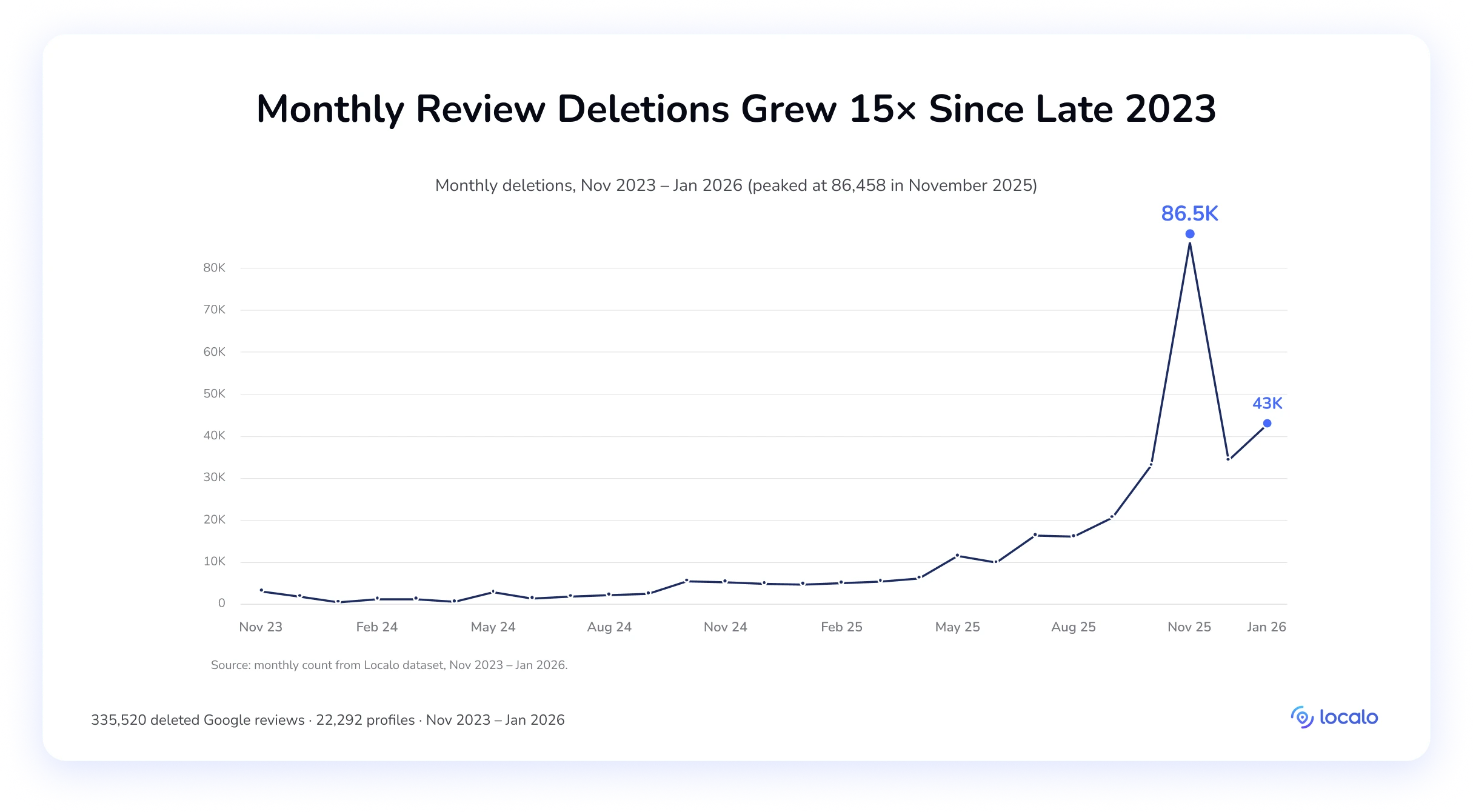
Localo also tracked the volume of fake reviews Google deleted each month. The average monthly number of deletions increased 15-fold from November 2023 to January 2026.
| Period | Avg monthly deletions | Growth vs late 2023 |
|---|---|---|
| Late 2023 (Nov-Dec) | 2,765 | baseline |
| H1 2024 (Jan-Jun) | 1,609 | -42% |
| H2 2024 (Jul-Dec) | 4,006 | +45% |
| H1 2025 (Jan-Jun) | 7,444 | +169% |
| H2 2025 (Jul-Dec) | 34,748 | +1,157% |
| Jan 2026 | 43,141 | +1,461% |
The numbers show that the biggest increase in Google review deletions happened in the second half of 2025.
Localo’s research findings are consistent with other reports from SEO experts. Michel van Luijtelaar’s research for Search Engine Land and GMBapi confirms that reviews get deleted at record levels since 2025. Google’s review algorithm is getting more effective at detecting fake or misleading content.
Why Review Velocity Is the Strongest Deletion Signal
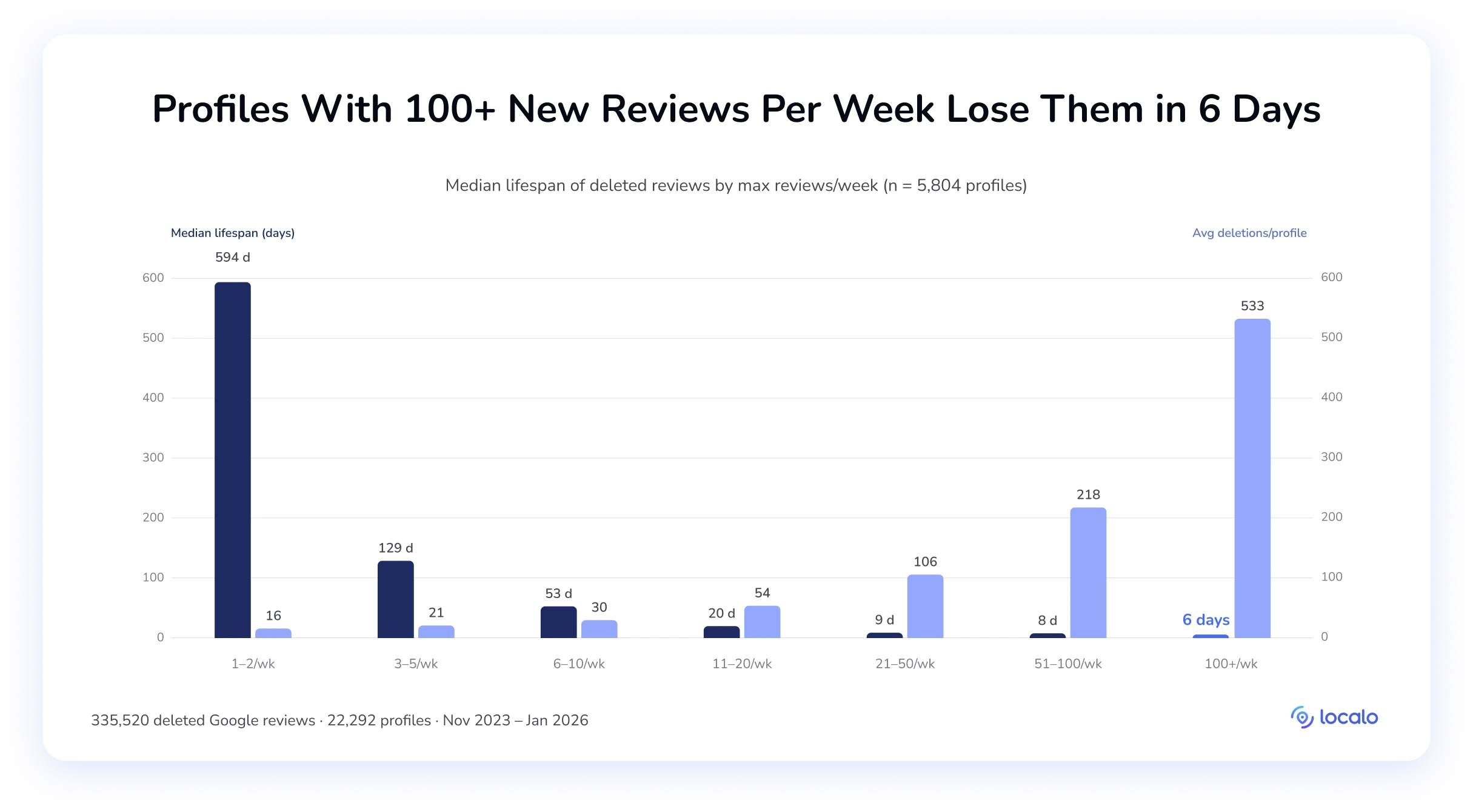
Review velocity expresses how many new reviews get published on a Google Business Profile within a specific time window. Localo’s data show that most businesses with 100+ new weekly reviews have their reviews removed within 6 days. To compare, profiles that get 1-2 reviews weekly keep their reviews for 594 days. That’s 99 times longer.
Increasing review velocity significantly decreases their lifespan. Moving from 1-2 reviews per week to 6-10 weekly cuts the review lifespan 11 times over. Upping it to 100+ new reviews weekly cuts it by another 9 times.
| Max reviews/week | Profiles | Median lifespan (days) | Avg deletions/profile | % 5-star |
|---|---|---|---|---|
| 1-2 | 773 | 594 days | 16 | 72.6% |
| 3-5 | 1,472 | 129 days | 21 | 86.6% |
| 6-10 | 1,557 | 53 days | 30 | 90.2% |
| 11-20 | 1,155 | 20 days | 54 | 91.4% |
| 21-50 | 639 | 9 days | 106 | 91.9% |
| 51-100 | 137 | 8 days | 218 | 91.9% |
| 100+ | 71 | 6 days | 533 | 93.4% |
When you want to increase local rankings fast, you may mistakenly believe that a surge in reviews will help, while the opposite is true. Based on the deletion patterns above, the safe organic ceiling sits around 1-5 reviews per week. It should be enough to grow a profile without crossing the velocity thresholds where Google’s algorithms start treating new reviews as suspicious.
🔎 Key takeaway:
High-velocity profiles lose Google reviews 99 times faster than typical GBPs. Set up regular reminders to check for content that violates Google review guidelines and see which Google reviews have already been deleted.
💡 Tip:
If you’re planning local SEO review campaigns for GBPs, you must spread them over time. Algorithms detect sudden surges in customer ratings and monitor for fake 5-star Google reviews on profiles that receive 20+ reviews weekly.
Do Velocity, 5-Star Concentration, and Low Reply Rate Trigger Batch Deletion?
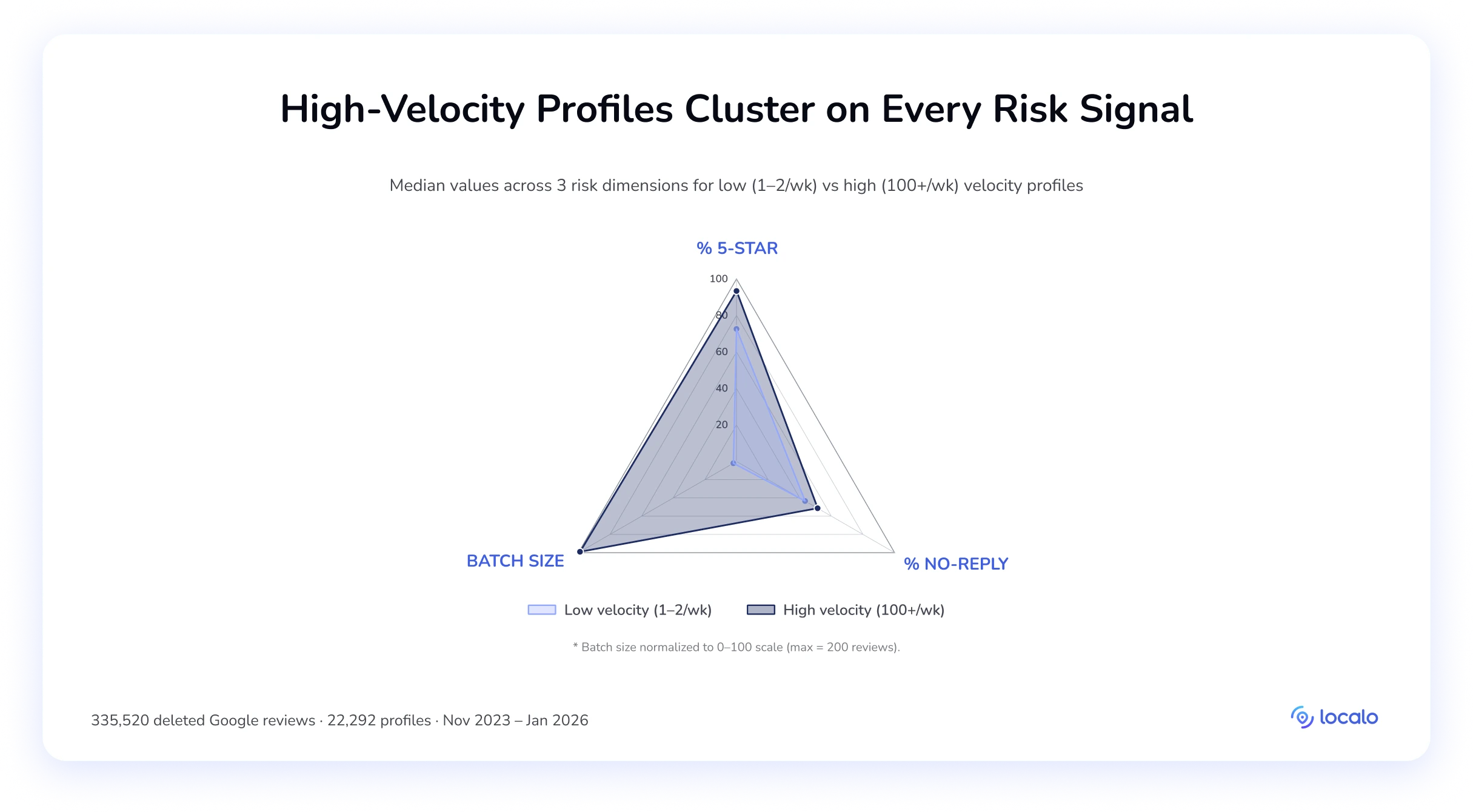
High-review-velocity profiles typically have many 5-star reviews and a lower business reply rate. Localo’s data shows that a combination of these factors triggers batch deletions. Average batch size scales sharply with velocity, from 4 reviews per batch on profiles getting 1-2 reviews per week to 198 reviews per batch on profiles getting 100+.
| Velocity group | % 5-star | % replied | Avg batch size |
|---|---|---|---|
| 1-2 / week | 72.6% | 56.6% | 4 |
| 6-10 / week | 90.2% | 65.9% | 11 |
| 21-50 / week | 91.9% | 61.5% | 35 |
| 100+ / week | 93.4% | 48.7% | 198 |
🔎 Key takeaway:
Google monitors review velocity as a trigger while algorithms check the content for confirmation.
💡 Tip:
On profiles where 5-star concentration crosses ~90% and reply rate dips below ~50%, Google has the two-signal pattern it needs to fire a batch deletion. Reverse the pattern: aim for a natural rating distribution and consistent personalized replies.
Does Generic Text Content Give Algorithms More Confirmation Than Rating-Only Reviews?
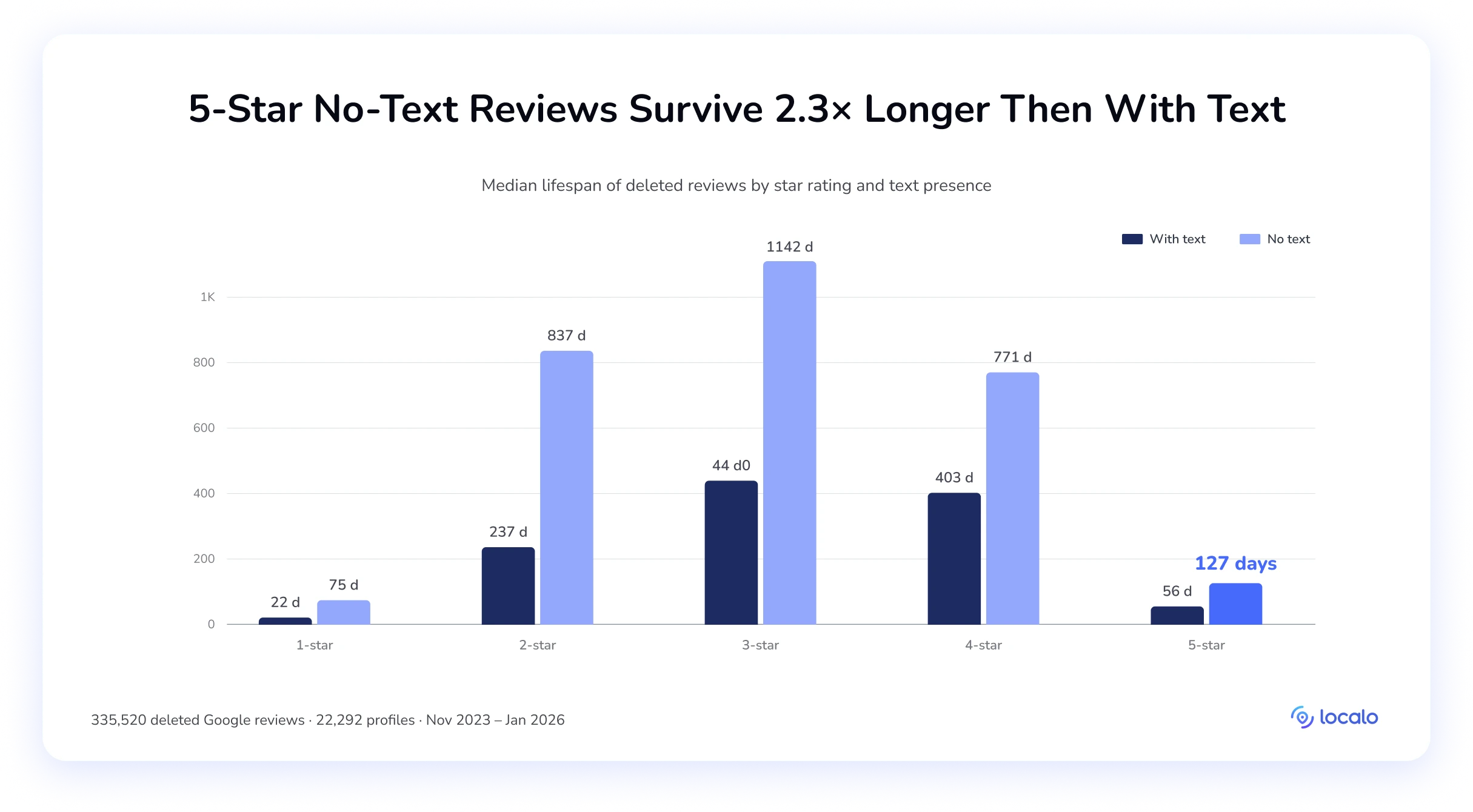
It’s not just about five-star reviews. Google’s moderation algorithms run NLP analysis on review text, and reviews without any text bypass that analysis layer entirely. Reviews without text stay on GBPs much longer than those with text content, and this applies to all star ratings.
Localo’s data in the table below shows that 5-star reviews without text last 2.3 times longer than those with text.
| Star rating | With text (median) | No text (median) | Difference |
|---|---|---|---|
| 1 star | 22 days | 75 days | 3.4x longer |
| 2 stars | 237 days | 837 days | 3.5x longer |
| 3 stars | 440 days | 1,142 days | 2.6x longer |
| 4 stars | 403 days | 771 days | 1.9x longer |
| 5 stars | 56 days | 127 days | 2.3x longer |
🔎 Key takeaway:
Since Google’s review algorithm analyzes user content, reviews without text survive longer, as they provide less data to confirm whether they’re fake. But the safety is conditional. On high-velocity profiles, rating-only reviews still get caught in batch deletions alongside text reviews.
💡 Tip:
Forget about buying fake Google reviews that consist solely of the star rating. Google will remove fake reviews without text if it notices suspicious user activity.
How to Calculate a Google Review Risk Score
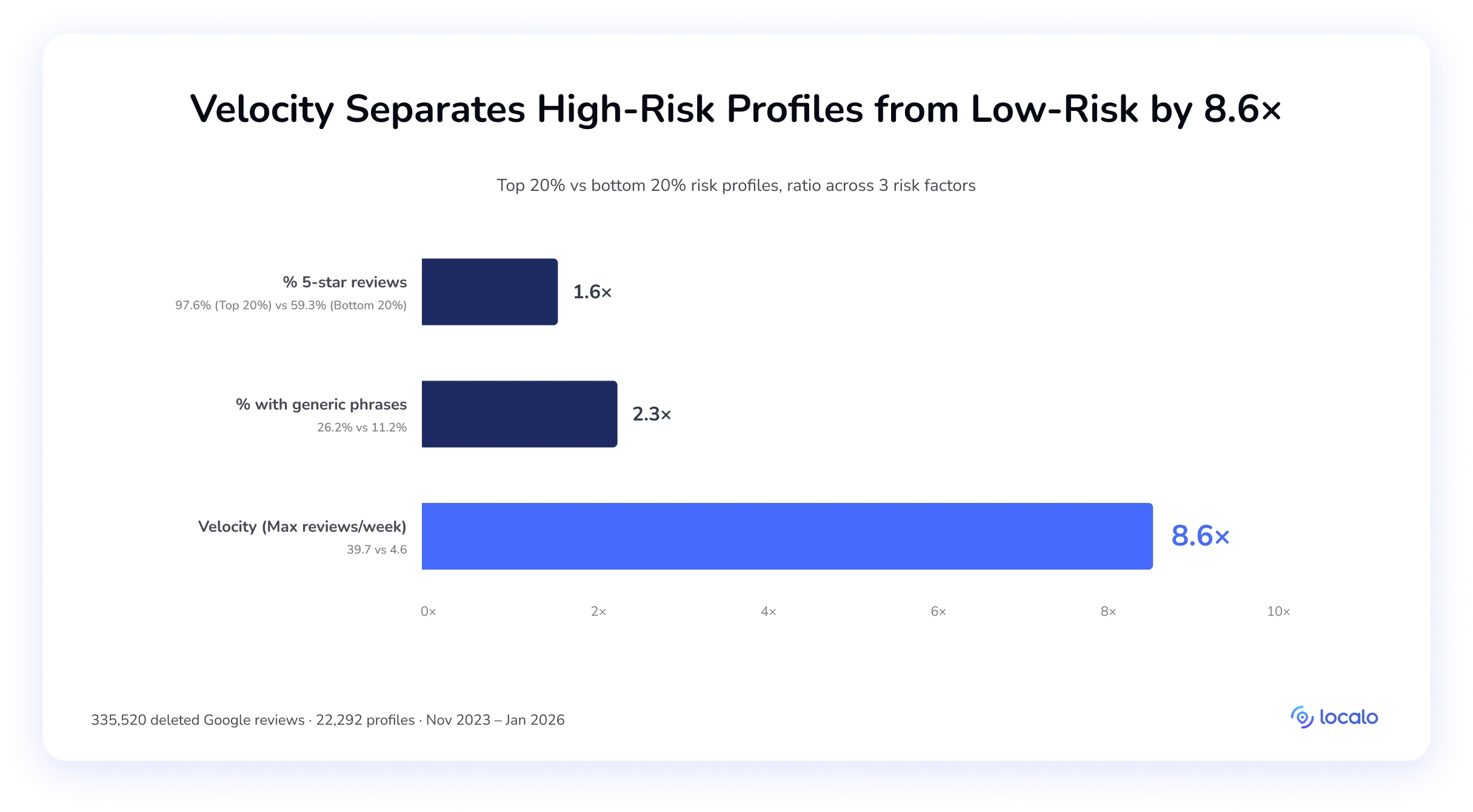
We scored each profile across multiple dimensions. Three factors stand out in high-risk GBPs: the popularity of 5-star reviews, the density of generic phrases like “highly recommend”, and a review velocity of 20+ new reviews per week.
To identify which factors separate high-risk from low-risk profiles, we sliced the 5,804-profile correlation set into top and bottom risk quintiles by Risk Score, then compared each factor across the two groups.
Localo’s data affirms that a high risk score predicts the removal of fake reviews on Google. You can see the difference between high-risk and low-risk profile behavior in the table below:
| Factor | Top 20% risk | Bottom 20% risk | Difference |
|---|---|---|---|
| % of 5-star reviews | 97.6% | 59.3% | 1.6x |
| % with generic phrases | 26.2% | 11.2% | 2.3x |
| Max reviews/week (velocity) | 39.7 | 4.6 | 8.6x |
| Avg deletions/profile | 114 | 23 | 5.0x |
🔎 Key takeaway:
If a GBP has over 90% of 5-star reviews, more than 20% of reviews using generic phrases like “highly recommend” or “excellent service,” and gets 20+ reviews in any single week, the profile is in the highest-risk category.
💡 Tip:
Maintain a neutral risk score by achieving a 70-85% ratio of 5-star reviews with authentic user feedback, and sustain steady organic growth at 2-5 reviews per week.
Why Owner Reply Speed Alone Isn’t a Deletion Predictor
At first glance, reply speed looks like it should predict review deletion, but the data shows it doesn’t.
Localo’s analysis found that reviews replied to within 24 hours and reviews with no reply at all have the highest 7-day removal rates (36.4% and 38.9% respectively), while reviews with slow owner replies (5+ days) have removal rates near zero. The pattern looks meaningful until you account for when those reviews were posted.
| Reply speed | Reviews | Median lifespan | Removed within 7 days |
|---|---|---|---|
| Under 1 hour | 22,390 | 49 days | 32.4% |
| 1-24 hours | 71,196 | 19 days | 36.4% |
| 1-5 days | 47,687 | 50 days | 24.0% |
| 5-10 days | 13,142 | 167 days | 2.8% |
| 10+ days | 38,145 | 311 days | 0.0% |
| No reply | 133,664 | 20 days | 38.9% |
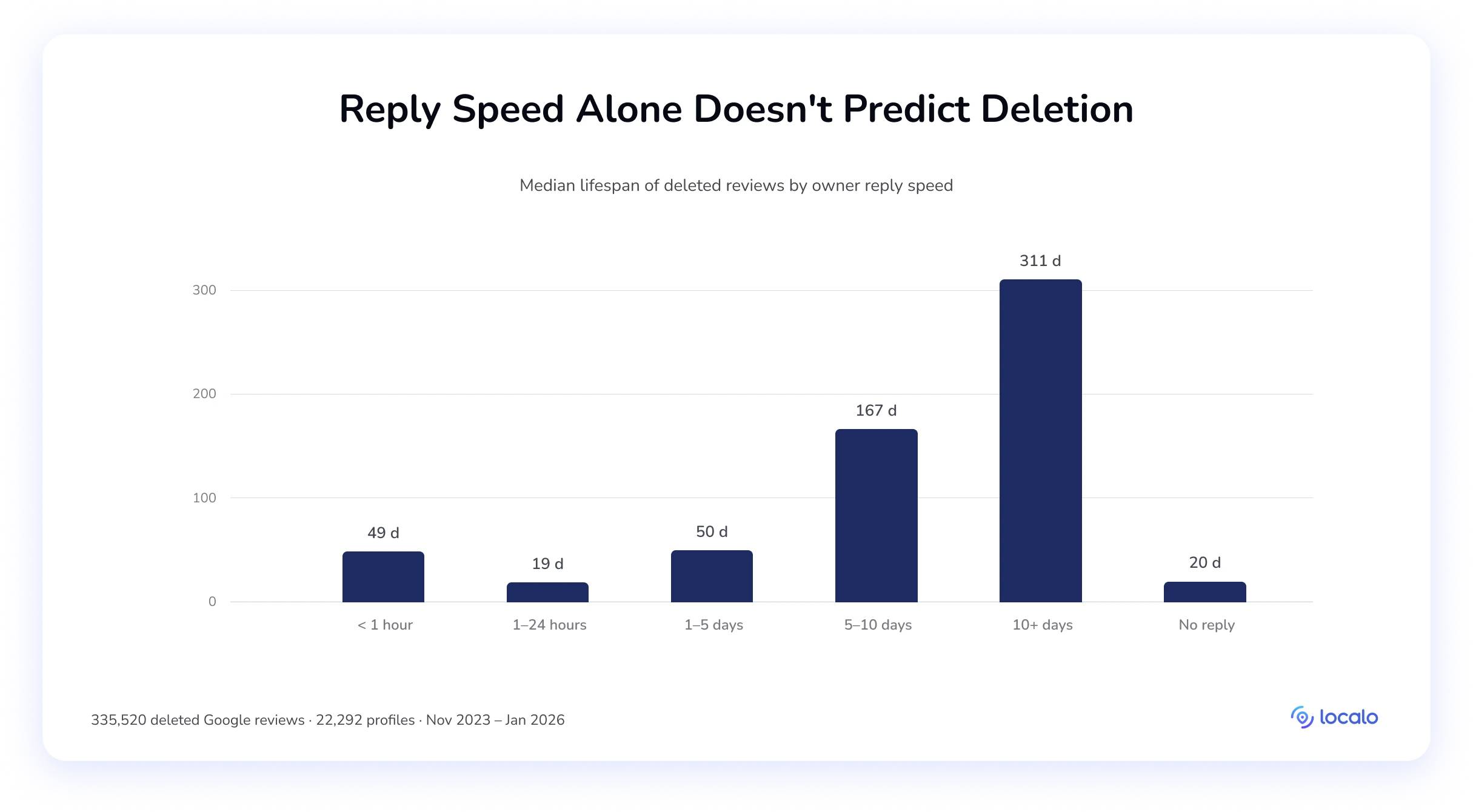
Reviews that received slow replies tend to be posted when Google’s algorithms were less aggressive overall. The newer, faster-removed cohort received quicker replies because both the reviewers and the owners were operating in the post-2025 acceleration window. The correlation between reply speed and deletion is a timing artifact, not a causal signal. Google’s algorithms aren’t classifying reviews based on how fast the owner replied.
🔎 Key takeaway:
Reply speed isn’t a standalone signal of fake reviews for Google.
💡 Tip:
Owner engagement is important for supporting customer relationships. Google review management software can help you post personalized, thoughtful replies instead of automatic, cookie-cutter templates.
How to Build Google Reviews Without Triggering Deletion
Building Google reviews takes time, but a strong, authentic reputation is worth the effort. Avoid quick fixes like buying reviews, as these can harm the business and your integrity. Instead, focus on encouraging honest feedback and creating strategies that build trust naturally.
Here’s what you can do to grow Google reviews and ratings organically:
1. Encourage Genuine Google Reviews at a 2-5/Week Pace
Grow Google reviews at a healthy pace of 2-5 reviews per week. It’s more effective than a sudden spike in fake 5-star reviews that will disappear in a week.
2. Ask Clients to Describe Specific Experiences
Specific information and authentic descriptions matter to potential customers as well as to Google. Generic phrases such as “excellent” or “highly recommend” often get flagged as fake. Additionally, encourage customers to leave reviews using the local vocabulary.
3. Respond With Personalized Messages
Replying to customers helps to strengthen relationships, as long as your responses are authentic and personal. Set up a regular reminder for GBP management and leave personalized replies to Google reviews. Automated, generic replies posted within minutes look fake from a mile away.
4. Do Not Aim for a Perfect 5 Google Rating
A perfect 5.0 score with only 5-star reviews is likely to be flagged as fake, prompting Google to remove the reviews and causing the score to drop significantly. Instead of striving for a perfect score, display genuine Google reviews on other channels to build credibility and encourage other customers to leave feedback.
5. Monitor Google Review Removal Monthly
A healthy Google review management strategy must include regular monitoring. Don’t assume that reviews are safe just because they’ve been posted weeks ago. If you notice fake content on your profile, report fake Google reviews immediately, so as not to risk getting your GBP suspended due to suspicious activity.
If you suspect that some reviews on a profile you’re managing were bought or gated, check the next section for the report-and-recover workflow.
What to Do When GBP Has Already Bought Reviews, or You Suspect a Profile Was Hit
When auditing a GBP, you may notice signs of Google policy violations.
How to Spot Bought or Gated Reviews on a Profile
You can recognize bought or gated reviews by the following red flags:
- Vague and generic content like “Excellent” or “highly recommended” without any specifics about the business or services.
- Reviewer history that doesn’t resemble natural user behavior, such as accounts posting hundreds of reviews across different locations each week.
- Sudden review timing surges, like an influx of 5-star or 1-star reviews in a short time.
- High density of rating-only reviews (clusters of reviews without any text).
- Generic or ultra-quick owner responses, a sign of automated reply patterns.
If you notice the red flags, check existing customer communication methods (email, text messages, CRM systems) to see whether any gating funnels are in place. Check also Google reviews that have already been removed.
How to Report Fake Reviews to Google
If you spot GBP reviews that go against Google’s business review policy, you should report them this way:
- Log in to your Google Business Profile
- Go to the Reviews section
- Navigate to the suspicious review, click the three dots (⋮), and select Report review
- Pick the appropriate reason for reporting
Gather evidence to support your request. For example, fake reviews may mention products or services that your business doesn’t offer. If the influx of fake negative reviews is part of an extortion scam, report it immediately.
How to Recover From a Review Posting Block, Batch Deletion, or Suspension
A review posting block appears in the Google Business Profile as a notification that reads: “Posting reviews is turned off for this profile.” It typically lasts 30 days, during which new customer reviews will be blocked or hidden.
While a GBP is suspended, reviews are invisible to the public. When a profile is reinstated, it normally reappears within 24-72 hours unless the suspension was due to review fraud. In that case, Google will likely delete all reviews they consider fake.
Once you realize a profile has been blocked or suspended, pause all review campaigns and CRM review triggers while the profile is under investigation.
If you suspect the block or suspension was caused by fake reviews bought in the past by your client, here’s what to do:
- Don’t panic-delete all fake reviews, as it will look even more suspicious
- Document all deletions to understand why they happened and prepare for an appeal, if necessary
- Let Google’s algorithms do the work
If the GBP you manage underwent a batch review deletion due to suspension, its local SEO rankings may take a hit. Focus your actions on rebuilding business’s reputation by collecting authentic reviews and posting regularly to show it’s legitimate.
Methodology
Localo’s analysis was based on 335,520 deleted Google reviews from 22,292 Business Profiles, tracked between November 2023 and January 2026, a 27-month measurement window. Reviews were collected across multiple countries and industries to identify patterns in deleted content and user behavior. Velocity was measured as the maximum number of reviews created per profile within any 7-day rolling window. The review lifespan was calculated as the difference between the review creation date and the removal date. Profiles with more than 10 deleted reviews were included in the correlation analysis (n=5,804 profiles).
Metric definitions used throughout this analysis:
- Median lifespan: days between a review’s creation date and its removal date.
- Max reviews/week: the highest count of new reviews observed in any 7-day rolling window for a given profile across the measurement period.
- Avg deletions/profile: cumulative number of reviews removed from each profile across the full 27-month window (not annualized).
- Avg batch size: mean number of reviews removed in a single deletion event on a profile.
- % 5-star, % with text, % with generic phrases, % replied: share of each profile’s deleted-review set, not its full review base.
- Lifespan by year created: deleted reviews grouped by their original creation year (not removal year). “2017: 2,902 days” means reviews originally posted in 2017 had a median of 2,902 days between posting and deletion.
Frequently Asked Questions About Buying Google Reviews
Is buying Google reviews a good idea for businesses or SEO agencies?
No. Don’t buy Google reviews from any websites that promise quick results in local rankings and visibility. Google review algorithms can spot unnatural patterns in user and owner activity, and fake Google reviews get deleted quickly.
Are fake Google reviews illegal?
Yes. In many countries, including the U.S., posting fake reviews on Google purposefully is illegal. The Federal Trade Commission can impose penalties of up to $53,088 per violation on businesses or individuals who commit review fraud.
Will Google remove fake reviews from your profile?
Yes, sooner or later. Suspicious behavior like a sudden spike in review velocity often triggers removal within days, sometimes within hours when batch deletions hit.
Are Google reviews fake?
Most Google reviews come from real users leaving genuine feedback. However, fake Google reviews are a recognized problem. In 2025, Google removed 292 million reviews from Google Business Profiles.
Sources
- Maps User Generated Content Policy Help, Maps user-generated content policy
- Maps User Generated Content Policy Help, Prohibited & restricted content
- Google Business Profile Help, Business Profile restrictions for policy violations
- Samantaray, B., (2026) New ways we’re protecting businesses on Maps, Google
- Blumenthal, M., (2019) Does Review Gating Impact Star-Ratings? GatherUp
- Hawkins, J., (2021) Review-Gating is Against the Google My Business Guidelines, SterlingSky
- Rozek, P. A., (2018) 4 Ways to Read Google’s No-Cherry-Picking Policy on Google Reviews, Local Visibility System
- Banks, J., (Updated 2025) Review Gating, BrightLocal
- Federal Trade Commission, 16 CFR Part 465: Trade Regulation Rule on the Use of Consumer Reviews and Testimonials (Final Rule)
- Hawkins, J., (2021) What Happens When Google Removes 98% of Your Reviews [Case Study], SterlingSky
- Google Business Profile Help, (2024) Suspended/Disabled profiles Troubleshooting and FAQs
- Office of Competition and Consumer Protection, (2023) Tailor-made reviews - UOKiK President presses charges against Best-Review
- Direction générale de la concurrence, de la consommation et de la répression des fraudes, (2023) Comment la DGCCRF enquête sur les faux avis
- Federal Ministry of Justice and Consumer Protection, (2024) Act against Unfair Competition (Gesetz gegen den unlauteren Wettbewerb - UWG)
- Burnett, A., (2025) Fake-Bewertungen: LG Düsseldorf verhängt 25.000 € Ordnungsgeld
- Lampmann, A., Fake-Bewertungen
- Federal Trade Commission, (2024) FTC Approves Final Order against Rytr, Seller of an AI “Testimonial & Review” Service, for Providing Subscribers with Means to Generate False and Deceptive Reviews
- Federal Trade Commission, (2025) FTC Takes Action Against Telemedicine Firm NextMed Over Charges It Used Misleading Prices, Fake Reviews, and Deceptive Weight Loss Claims to Sell GLP-1 Weight-Loss Programs
- van Luijtelaar, M.,(2025) Why Google is deleting reviews at record levels. Search Engine Land
- van Luijtelaar, M., (2025) The Global Wave of Deleted Google Reviews: What Our Data Reveals About AI, Law, and Trust. GMBapi.com
- Tomina, C., (2026) Review Posting Blocks Are Surging. Here’s the Data Plus the Patterns Behind Them, SterlingSky
- Somborac, S., (2026) The Ultimate Playbook for Google Business Profile Suspensions, SterlingSky
- Google Business Profile Help, Report negative review extortion scam on your Business Profile