
You know how to do local SEO. You can optimize a Google Business Profile, improve local rankings, and deliver real results. But getting clients? That’s a completely different skill.
Over 46% of all Google searches are for local businesses, making local search rankings a major focus for marketing campaigns because they directly impact visibility and customer acquisition.
Most agencies and freelancers face the same problems: decision paralysis about who to contact, wasted time on random outreach, and proposals sent to businesses that were never going to convert.
In this guide, I’ll share what actually works for getting local SEO leads, based on real experiences from practitioners in the field and lessons learned from years of helping agencies and freelancers grow. Practical strategies you can start using today.
Here we go!
Reasons Why Traditional Outreach Fails for Local Businesses
Let me share a real example. A freelancer recently contacted a local business through their website. Here’s what they wrote:
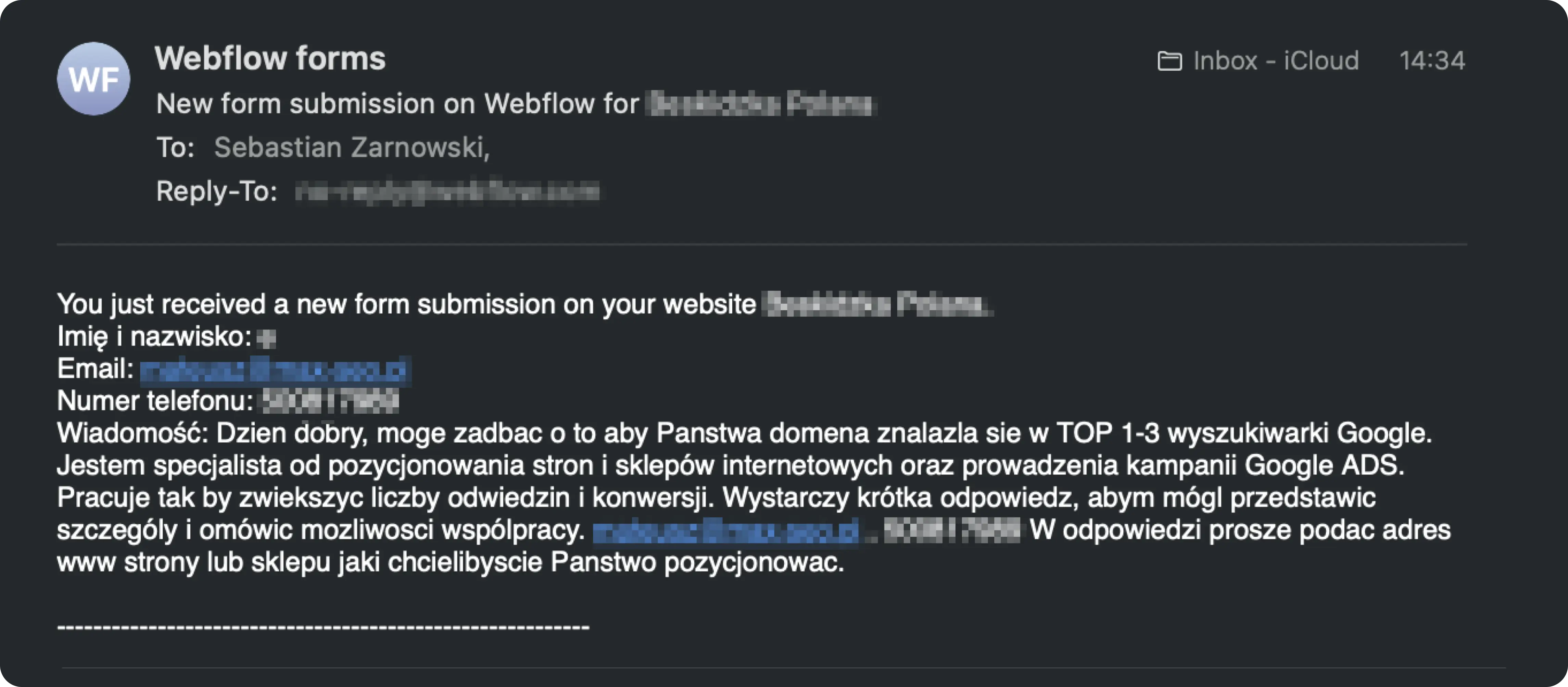
“I can help your domain rank in TOP 1-3 of search engines and increase conversions.”
The business owners had no idea what “domain,” “TOP 1-3,” or “conversions” even meant. They didn’t see a problem, so they didn’t see a need. The freelancer wanted to discuss collaboration, but the conversation was dead before it started.
This happens constantly. Outreach attempts fail because they focus on complex SEO concepts and technical jargon, rather than translating SEO concepts into clear business benefits that matter to the client. Here are other reasons why most outreach fails:
1. Contacting Random SEO Leads
People doing local SEO work often don’t know who to contact. So they reach out to everyone, hoping something sticks.
Lead generation tools don’t help here either. They promise massive lists with contacts, but these are unfiltered and unqualified, creating bidding wars with oversaturated leads. You end up begging people who are already bombarded by competitors. Instead of solving your problem, they create more work.
2. No Proof
Freelancers claim “you’re ranking low” but show no evidence. The business owner then searches from their own location, sees themselves at position #1, and assumes it’s a scam. Without visual proof of the actual visibility problem across the service area, your claim looks like a lie.
3. Speaking in Jargon About SEO Strategy
Business owners don’t care about “domains” or “search engine optimization.” They care about customers finding them. When you lead with technical language, you lose them immediately. Instead, simplify complex SEO concepts and focus on client-centric benefits rather than technical jargon to clearly show how your services drive real business results.
4. Mass Outreach Without Personalization
One practitioner put it well: “Mass emailing 100k+ people is useless compared to sending 10 genuinely personalized emails.” Yet people still spend hours setting up automation sequences, crafting email templates, and configuring follow-up workflows. The result? Response rates close to zero and a lot of wasted effort.
5. Proposals for Unqualified Prospects
Here’s what happens: you contact a random business, they politely say “sure, send me an offer,” and you spend hours preparing a proposal. But they were never going to buy. They ask for the offer knowing they won’t accept it.
The result? Wasted proposals, frustrated salespeople, and no clients.


What Actually Works to Get Local SEO Leads
So what does work in finding local SEO clients?
Type “getting local SEO clients” into Reddit’s r/localseo and you’ll find an endless scroll of threads. “How do you get your clients today?” “How do people actually get local SEO clients?” Each with 20-60 comments. Rookies asking for advice, frustrated specialists sharing what finally worked, veterans helping out.
The most recent one as I’m writing this? Posted 19 hours ago: “I can deliver results, but I’m still struggling to get a real break in local SEO.”
I went through these threads and pulled out what practitioners actually report is working. Here’s what came up again and again.
Word of Mouth and Referrals
This is the most frequently mentioned method by far. And not just as a nice bonus, but as the primary source of clients for established agencies and freelancers.
One practitioner shared: “My average retention is about 6 years on core clients. You don’t need many new clients if the old ones don’t leave.”
Another noted their client acquisition math: with 6-year average retention, they only need to close about one client every two years to maintain steady growth. That’s the power of referrals compounding over time.
The key insight? Do great work for clients you have. Results generate referrals. Referrals generate more clients. It compounds.
Local Networking and Business Events
Chambers of commerce, local business groups, and industry meetups consistently appear as high-quality lead sources.
One comment put it directly: “If you live in America, go to a local chamber of commerce meeting that is for ‘marketing.’ Everyone in that room clearly needs help and is motivated to grow their business.”
The advantage here is simple: you’re meeting people who already acknowledge they need marketing help. No convincing required.
Partnerships work too. One practitioner shared: “I’m getting clients through networking and building partnerships. Business consultants, branding agencies, agencies who only do social media.” These complementary service providers don’t compete with you. They refer clients who already trust them.
Building Trust Through Value First
Joy Hawkins, a well-known local SEO expert, shared her approach: “When I was first starting out, the first place I got active was online forums. I would offer advice, not be promotional at all, but eventually had people start contacting me if they saw I knew what I was talking about.”
This pattern showed up repeatedly. Provide value publicly. Help people without asking for anything. Build a reputation. Let clients come to you.
Social Proof and Case Studies
Screenshots of results. Before-and-after comparisons. Specific metrics. These convert skeptics into clients.
One practitioner described their approach: building “honeypots” where they document real results. When prospects visit their site, they see undeniable evidence of success.
The principle is straightforward: show, don’t tell.
Strategic Niche Specialization
Several commenters mentioned that targeting a specific industry often works better than targeting a geographic area.
One observation: “Agencies I know that actually use SEO as a lead gen strategy are usually ranking for industry-specific queries as opposed to geographic-specific queries.”
Instead of trying to rank for “SEO agency Chicago,” they target “SEO for dentists” or “local SEO for plumbers.” The leads are more qualified because they’re already looking for someone who understands their business.
LinkedIn and Online Community Engagement
Facebook groups, Reddit communities, and LinkedIn all came up as places where agencies find clients. But not through direct pitching.
The approach that works: participate genuinely. Answer questions. Share insights. Become a known, trusted voice. When someone in the group needs help, your name comes up.
How to Qualify Leads Among Local Business Owners
Not every business is worth contacting. The key is knowing who actually needs your help before you reach out.
Here’s what to look for:
Businesses That Are Actually Invisible In Search Results
This sounds obvious, but most people skip this step. Before you contact anyone, check if they’re actually invisible for keywords that matter to their business. A restaurant that doesn’t show up for “Italian restaurant” searches in their area? That’s a prospect. A plumber ranking #1 across their entire service area? Move on.
Sales Triggers That Signal Opportunity
Look for specific indicators:
- No website (they need digital presence help)
- Few reviews or low ratings (online reputation and ranking signals gap)
- Incomplete Google Business Profile (optimization opportunity)
- High growth potential in their area (room to improve visibility)
These signals tell you the business has space to grow and will likely see value in your services.
Additionally, ensure the business has consistent NAP (Name, Address, Phone number) information across all online platforms, as this is essential for strengthening local SEO.
Keywords That Matter to Their Business
Don’t just check if they rank for generic terms. Check the keywords their customers actually use. A dentist might rank fine for “dentist” but be invisible for “emergency dentist” or “teeth whitening.” Find the gaps that matter.
Competition Outranking Them in Their Local Area
When a business sees the competitor down the street ranking higher, that’s motivation. Look for situations where local competitors have better visibility. This creates urgency.
Businesses That Value Their Digital Presence
Some indicators: they have a website (even if basic), they’ve claimed their Google Business Profile, they respond to reviews occasionally. These businesses understand online presence matters. They’re more likely to invest in improving it.
Qualifying prospects before reaching out saves you hours of wasted proposals and conversations that go nowhere.
The Missing Piece: Proof That Potential Clients Can See and Believe
You can network, post in Facebook groups, and build a great portfolio. But when you reach out to a prospect, you still need one thing: proof that they actually have a problem.
The best way to get clients for Google Business Profile optimization is to reach out to businesses that are actually invisible to nearby customers for keywords that matter to them. Then show them this through a visual example they can verify themselves.
This is where most outreach falls apart. You tell a business owner they’re ranking low. They search from their office, see themselves at position #1, and think you’re lying. Conversation over.
But when you show them a Position Map, everything changes. They see their visibility across the entire service area, not just from where they’re standing. They click through different points on the map and realize: “I’m invisible here. And here. And here too.”
That’s frustration.
Then they see the competitor down the street ranking higher in all those spots.
That’s even bigger frustration.
And that frustration turns into action. They want to fix it. They want to see a map where they’re in position #1 and fully visible everywhere.
This is the WOW and AHA moment. It’s not about convincing someone they have a problem. It’s about showing them proof they can see with their own eyes.
Talking about visibility issues is one thing. Having visual proof is a whole other deal.
Client Acquisition in Localo: Find, Analyze, and Win Clients in One Tool
Everything I’ve described so far, finding the right prospects, checking their visibility, creating visual proof, it all takes time when you’re juggling tactics and multiple tools. Spreadsheets for tracking. Separate tools for visibility checks. CRMs for contact management. It slows everything down.
That’s why we built Client Acquisition in Localo.
One tool for the entire process: from finding businesses that actually need help, to showing them visual proof of their visibility gaps, to tracking your outreach, to activating them as clients.
Here’s how it works:
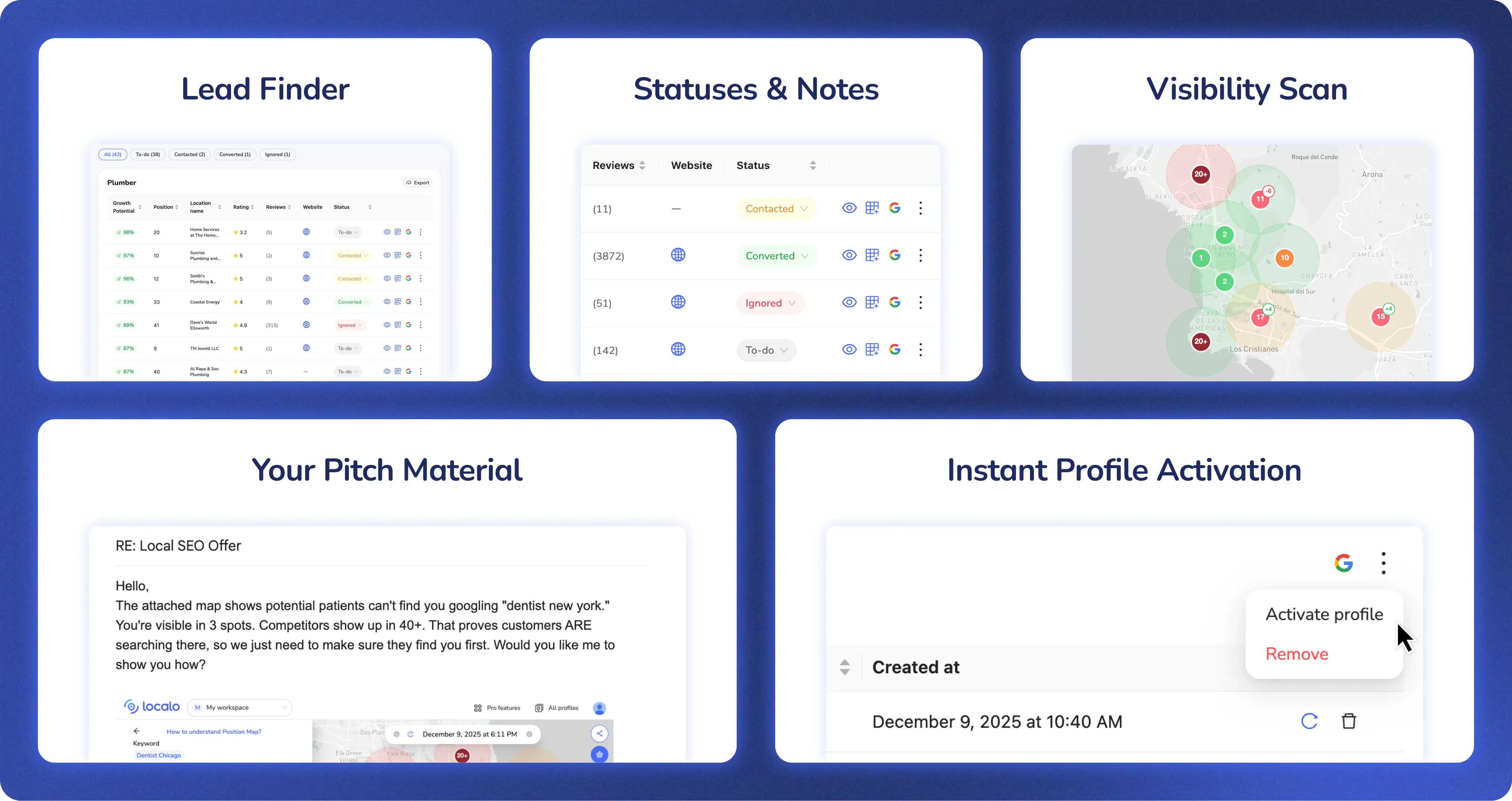
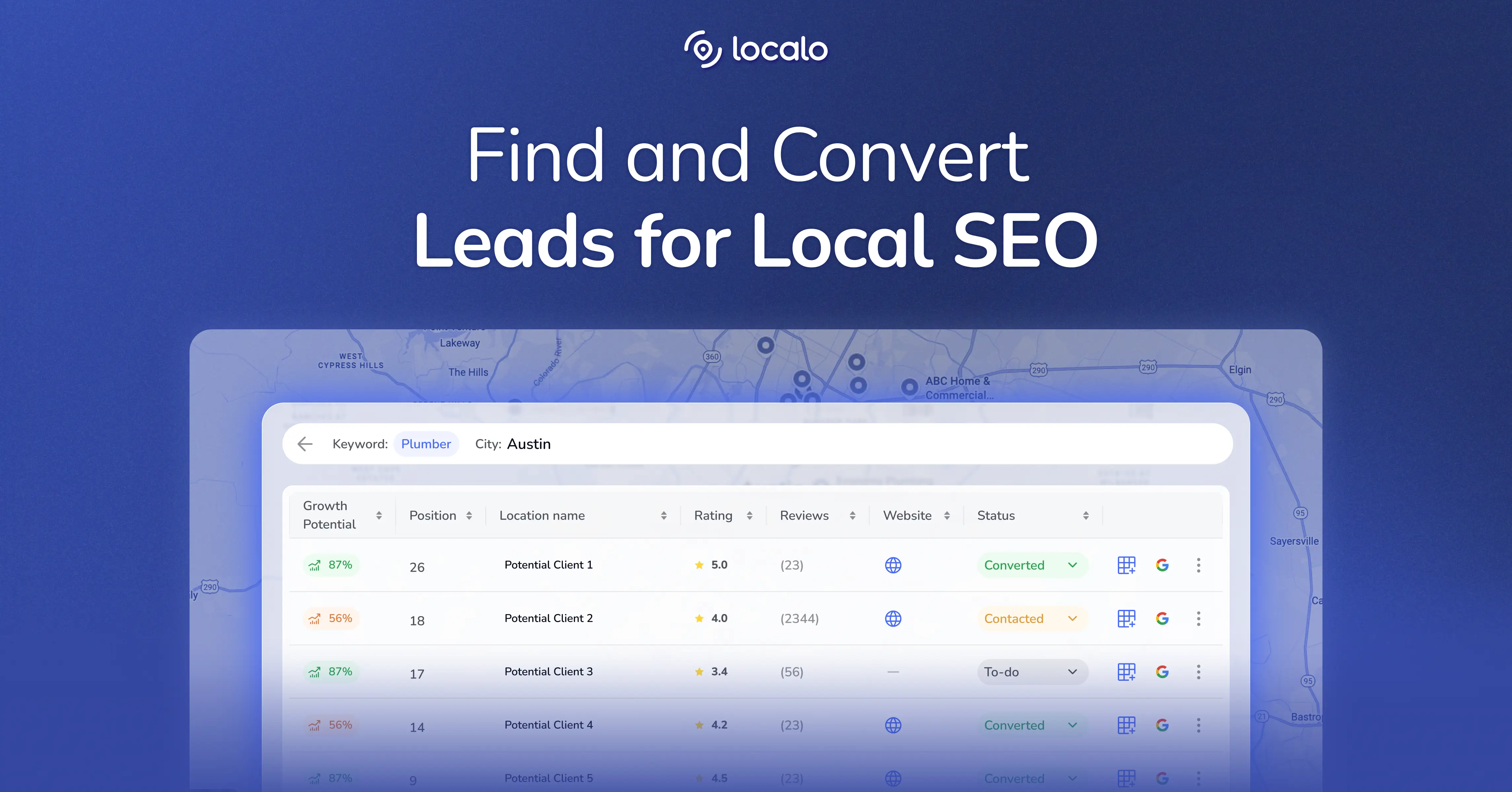
Lead Finder
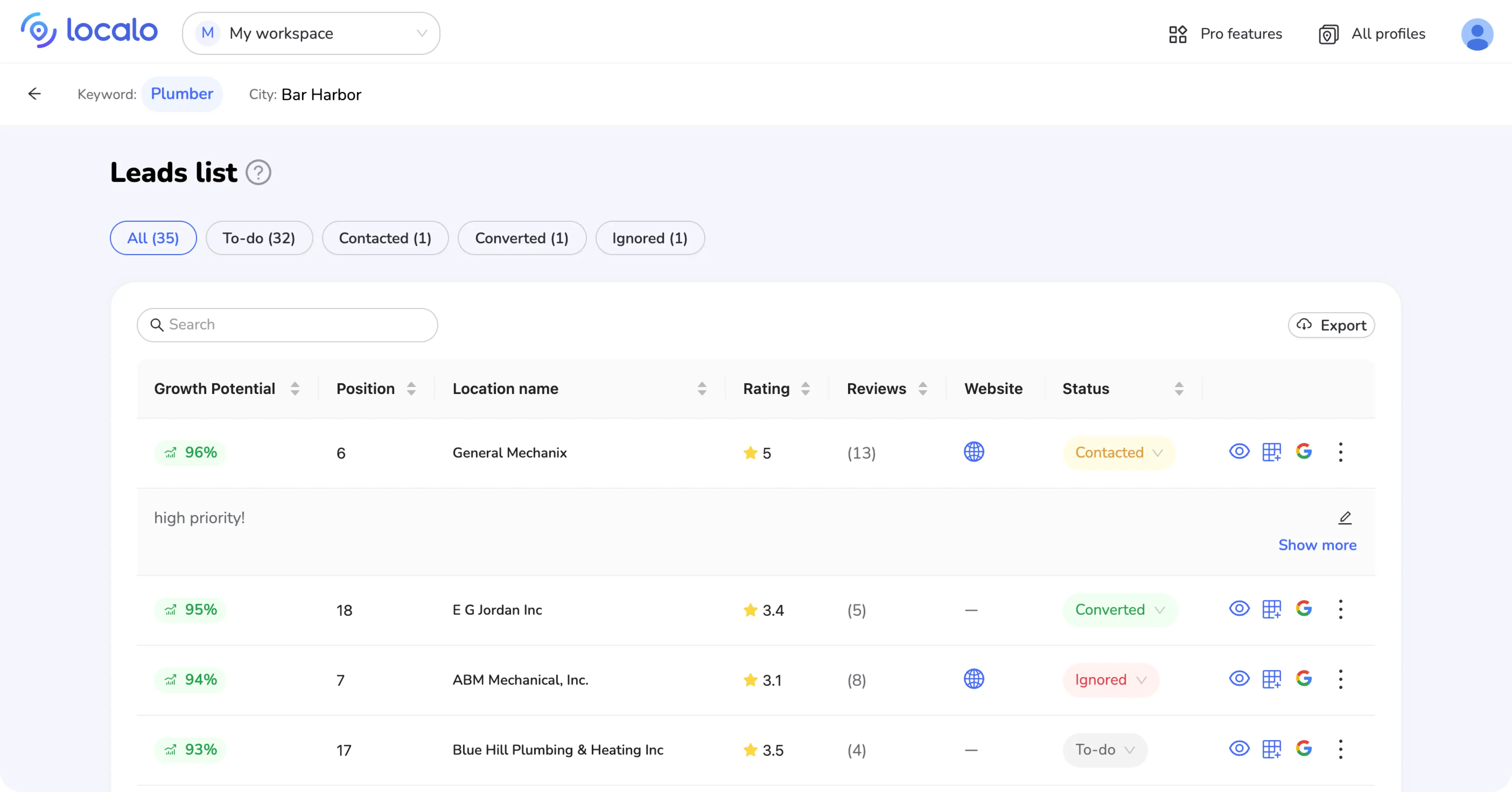
Enter a keyword and a city. That’s it.
Lead Finder gives you a list of local businesses with data that actually means something:
- Growth Potential score (1-100%) — See which businesses have the most room to improve. No more guessing who’s worth contacting.
- Sales triggers — Sort by no website, few reviews, low visibility. Get the whole picture for the businesses that clearly need help.
- Status tracking — Mark prospects as To-do, Contacted, Converted, or Ignored. Keep your pipeline organized without spreadsheets.
- Notes — Add comments to each prospect. Remember what you discussed and when.
This isn’t another spreadsheet with a thousand random contacts. It’s a filtered list of businesses with real growth potential in your target area and niche.
Visibility Scans
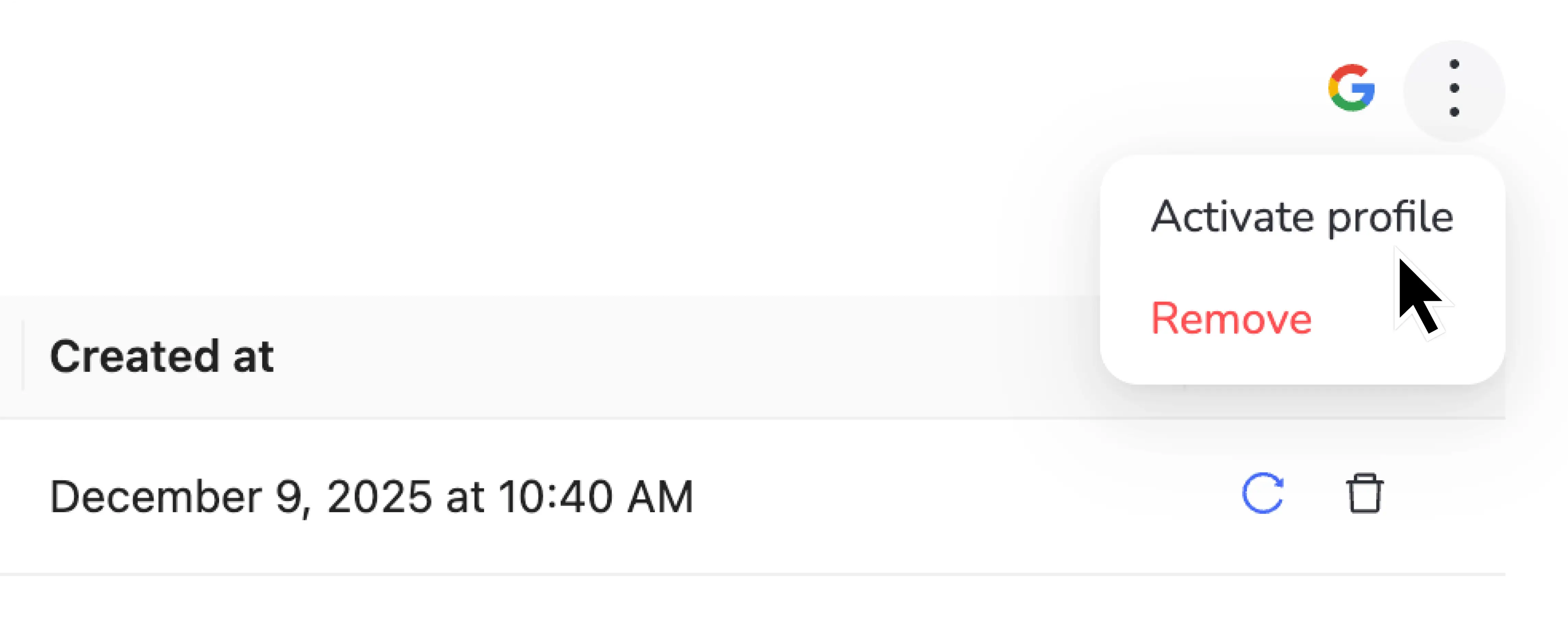
Closed the deal? Click “Activate Profile” and move your new client directly into active client profiles in Localo. Connect it to Google and start optimizing their Google Business Profile immediately.
Client Acquisition Steps in Practice
- Open Client Acquisition → Lead Finder
- Search your niche + target city (e.g., “dentist” in “Austin”)
- Sort by Growth Potential descending
- Select a business with clear sales triggers (for example, no website or few and old reviews)
- Run a Visibility Scan for keywords that matter to their business (we also suggest them)
- Review the Position Map and identify visibility gaps and opportunities
- Share the link to the Position Map in your pitch
- After closing → Click “Activate Profile” and start working
What This Solves
| Problem | Solution |
|---|---|
| “I don’t know who to contact” | Growth Potential scoring shows you exactly who needs help |
| “I have no proof” | Position Maps give you visual evidence prospects can verify themselves |
| “My sales and research are split across too many tools” | Everything in one place, from lead to client |
| “I waste time on unqualified prospects” | Filters and sales triggers surface businesses worth your time |
| “I lose track of who I’ve contacted” | Status tracking keeps your pipeline organized |
Communicating With Leads Without Jargon
You’ve got the right prospect. You’ve got the proof. Now you need a pitch that actually lands.
This is where most outreach falls apart. Don’t talk about SEO. Your prospect? They’re a business owner. They think about customers, phone calls, and people walking through the door.
Your message needs to speak their language. Translating complex SEO concepts into clear business benefits helps clients understand the value of your services and makes your offer more compelling.
Remember that cold email from earlier? “Domain,” “TOP 1-3,” “conversions.” None of those words mean anything to the average plumber or dentist. Here’s how to translate your pitch:
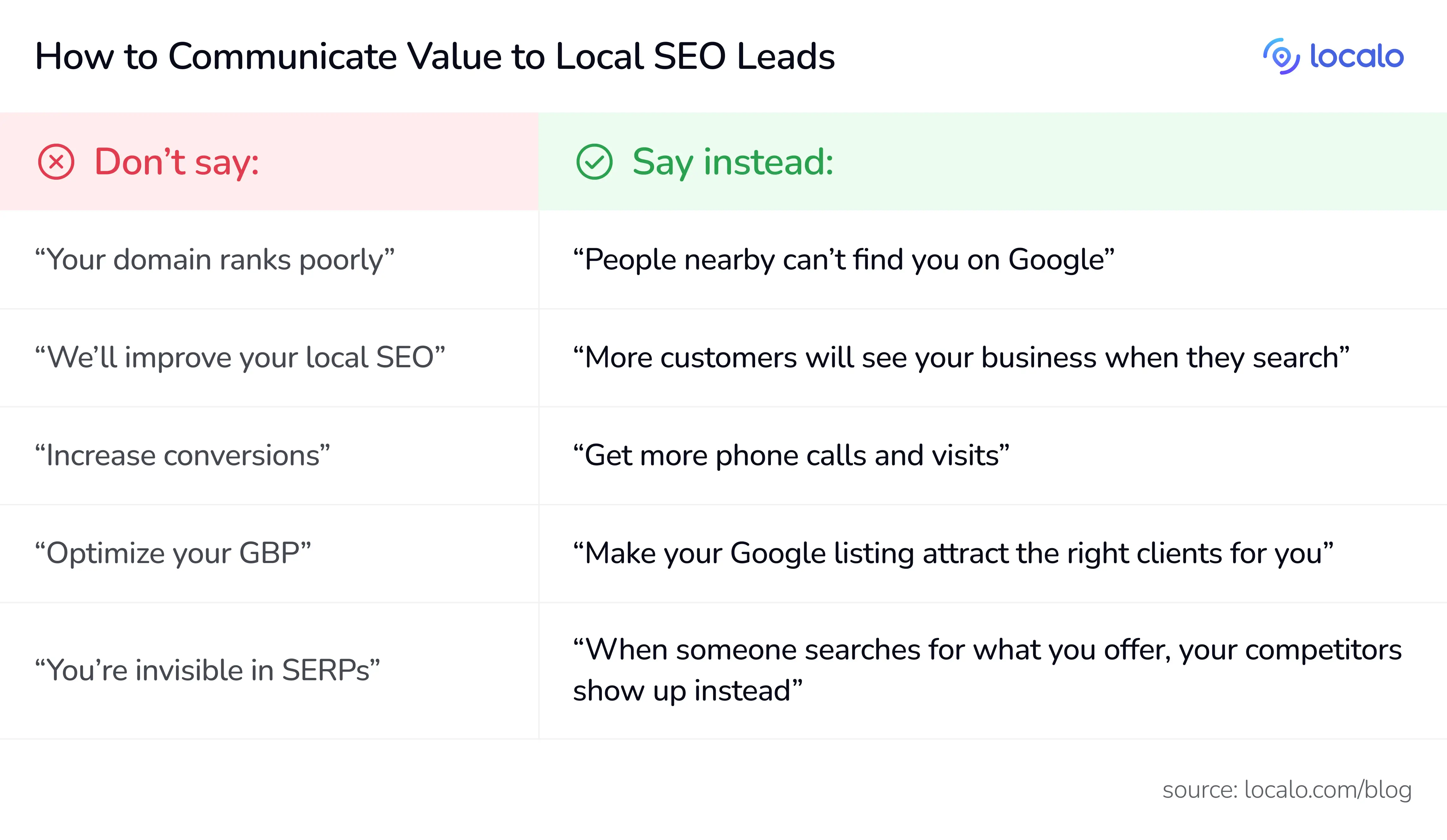
The Position Map helps here too. Instead of explaining ranking factors or search algorithms in your pitch, you attach the map. They see the problem instantly. No jargon needed.
One simple rule for writing outreach: if your parents wouldn’t understand what you’re saying, rephrase it. Setting realistic expectations from the start also helps build trust and transparency with clients.
Building Long-Term Client Relationships
Winning a client is one thing. Keeping them is another.
One of the biggest fears in this business? Clients who leave once their rankings improve. They see local SEO as a one-time fix, not an ongoing investment. That’s a communication problem, not a service problem.
Here’s how to build relationships that last:
Understand their goals first. Before diving into rankings and visibility, ask what the business wants to achieve in the upcoming months. Opening a new location? Launching a seasonal service? Targeting a new customer segment?
When you know their goals, you can align your local SEO work with what actually matters to them. Regular strategy reviews keep this alignment on track as their business evolves.
Set expectations early. During onboarding, explain that local visibility requires maintenance. Google updates its algorithm constantly. Competitors optimize their profiles. Reviews need responses. This isn’t a project with an end date.
Show ongoing value. Monthly reports shouldn’t just list tasks completed. They should answer the question every client secretly asks: “Is this still worth paying for?”
But here’s the key: report on what matters to them, not just what matters to you as a specialist. If they care about phone calls, show phone call growth. If they care about foot traffic, highlight direction requests. Show ranking changes, new customer actions, review growth. Connect your work to their unique business needs. Make the value impossible to miss.
Celebrate wins together. When a client hits the Local Pack for their main keyword, tell them. When their calls increase, point it out. These moments build trust and remind them why they hired you.
The best client relationships don’t feel like vendor contracts. They feel like partnerships.
Conclusion
Getting local SEO clients doesn’t require a massive budget or endless cold outreach. It requires the right approach: targeting businesses that are actually invisible, showing them proof they can verify themselves, and communicating in language they understand.
The agencies and freelancers who struggle? They’re still blasting generic emails to random contacts, hoping something sticks.
The ones who thrive? They find the right prospects, lead with visual proof, and build relationships that last.
Localo’s Client Acquisition brings this entire process into one place. Find leads with real growth potential, generate Position Maps that sell for you, and onboard new clients with a single click.
Your next client is out there, searching for help. Now you know how to find them.
Key takeaways:
- Focus on businesses with low online visibility for higher conversion rates.
- Use visual evidence, such as Position Maps, to demonstrate value.
- Personalize your outreach and communicate in clear, client-friendly language.
- Build long-term relationships, not just one-off sales.
- Use tools to generate leads and onboard won clients.
These key takeaways summarize essential strategies and actionable insights to help you get local SEO leads effectively.
Good luck!