
A local business builds brand consistency by communicating the same facts about its identity, services, customers, service area, delivery methods and reasons to choose it. Localo Brand Voice supports this consistency by combining business facts and communication guidelines in one brand description. The website, Google Business Profile, social media and directories should describe the same business in the same brand voice.
A business defines its brand identity and controls its communication. A consistent brand image develops in the audience’s mind when successive encounters reinforce the same understanding of the business. Brand consistency allows different wording and formats across channels, provided the information retains its meaning. Google and AI systems interpret a business as an entity connected to services, audiences and locations. Consistency in the entity’s description is not a standalone ranking factor, but helps systems match the business to complex queries.
Brand voice brings personality, language, style and tone of voice together into a verbal identity. The voice remains relatively stable, while tone adapts to the situation. Brand voice alone does not give AI models enough context: it defines how the brand should speak, but not what the brand can say about itself.
Localo Brand Voice adds a second layer to communication guidelines: structured knowledge about the brand. The module gathers information from the Google Business Profile, the business website and online mentions. Profiles of businesses in the same industry and local competitors serve only as reference points. Localo then organizes the information, identifies contradictions between sources and enriches the description through benchmarking. The module supports the creation of posts, service descriptions and review responses through the Localo AI Agent. The resulting description can serve as a reference for directories, partners and external publishers. The brand information model described here and implemented in Localo Brand Voice was developed jointly by the author, Maciej Markowski, and the Localo team.
Brand communication: what does a local business communicate online?
Local brand communication covers all information a business publishes and shares with its audiences online. The information describes the business, its services, customers, service area, service delivery and reasons to choose the brand.
Brand information appears in different channels and formats. A website can explain a service in detail, while a Google Business Profile presents the essentials. Social media can address a selected topic in a shorter format. Together, these communications shape how customers, Google and AI systems understand the business.
Online communication channels for a local business
A local business communicates information about its operations primarily through 4 types of online communication channels.
- The website describes the offering, audiences, service delivery, team and locations.
- The Google Business Profile presents the business, services, updates, customer reviews and responses to reviews.
- Social media channels share shorter messages, updates and replies addressed directly to audiences.
- Directories and external publications present business information published or edited by other organizations.
Each channel covers a different range of information, but all should describe the same business. Agreement on the offering, audiences and service area provides the basis for consistent brand communication.

What are brand identity, brand communication and brand image?
Brand identity is how a brand defines itself; brand communication conveys that identity; brand image is how audiences perceive it. Identity establishes who the brand is and what it represents. Communication expresses that identity through the website, Google Business Profile, social media and other channels. Audiences form a brand image through their encounters with these messages.
A brand can define its identity and control its communication, but cannot directly control its image. A consistent image develops when successive encounters reinforce the same understanding of the business.
Customers rarely discover a business in a planned sequence. Their first encounter might be a service description, Google Business Profile, social media post, review response or external publication. Each message provides part of the information from which customers build an overall picture of the brand.
A beauty salon might describe itself on its website as a clinic specializing in skin concerns. Its Google Business Profile might emphasize aesthetic treatments, while its social media focuses on facial massage. All 3 descriptions could be accurate, yet together fail to explain the salon’s specialty clearly. In this example, the inconsistent image results from the absence of a clear, unified brand description rather than inaccurate information.
Brand personality and communication
Brand personality is the character a brand expresses through communication. Qualities such as matter-of-factness, directness, formality, calmness and humor influence how audiences perceive the brand.
Declaring a quality does not establish that perception. A brand can call itself professional, but its language, explanations and conversations with customers must demonstrate professionalism.
Brand image therefore develops from 2 layers of communication: what the brand says and how it says it. Content conveys information about the business. Language, style and tone shape how audiences receive that information. Together, these layers create a brand experience that audiences, Google and AI systems interpret.
Consistent brand communication: the core topics that describe a business
Brand consistency means communicating compatible information across every channel about the following 6 core aspects of the business.
- Who the business is.
- What the business offers.
- Whom the business helps.
- Where the business operates.
- How the business delivers its services.
- Why customers might choose the business over alternatives.
Consistency concerns meaning, rather than the repetition of identical sentences. The website, Google Business Profile, social media and external publications can vary in wording and detail. Each should describe the same business, offering, customer groups and service area. These 6 aspects form the basis of the information model used in Localo Brand Voice.
Consistency does not require identical messages
The same brand fact can be expressed in different ways without losing consistency. “We provide services in Warsaw and the surrounding area” and “We serve customers in Warsaw and nearby towns” use different wording. Both convey essentially the same information about the business’s service area.
Inconsistency arises when the meaning changes. Audiences and content analysis systems receive conflicting descriptions if one channel names Warsaw and its surrounding area while another suggests nationwide coverage. Consistent communication allows the format to suit the channel and situation while preserving the facts and meanings that describe the business.
How do Google and AI use a consistent brand description?
Google and AI systems interpret a business as an entity connected to services, locations, service areas, audiences and other business attributes. Agreement across the online sources that mention the brand strengthens the credibility of this information.
Consistency in an entity’s description is not a standalone ranking factor. Its role is to provide systems with uniform brand information and reduce contradictions across different references to the business. Relevance to the user’s query is a ranking factor. The more closely content matches search intent, the easier it is for a system to connect a user’s need with a suitable offering.
These relationships matter more as queries become more complex. A query such as “physiotherapist Kraków” mainly requires a connection between a service and a location. “Physiotherapist offering home visits for an older stroke survivor in Kraków” requires several connected facts about the same business. The system must connect the service, customer group, need, delivery method and location. Consistent descriptions of these facts and relationships make it easier for Google and AI systems to match the business to a specific, complex query.
A unified brand description is therefore a key resource. The description should explain who the brand is, what it offers, whom it helps and where it operates. It should explain how the business delivers its services and why customers might choose it over alternatives. The same information should inform each channel, using the established brand voice and appropriate tone. The description belongs across the online presence, including the About Us page, Google Business Profile, business directories, industry publications and social media profiles. NAP directories list the business’s name, address and phone number.
Brand voice: personality, language, style and tone
Brand voice is the consistent way a brand communicates and builds relationships with its audiences. The voice remains recognizable across channels and publication formats, although its application can change with the situation.
Brand voice comprises the following 4 elements, which together form the brand’s verbal identity across its communications.
- Brand personality defines the brand’s character and role in its relationship with the audience, such as expert, adviser or partner.
- Brand language defines vocabulary, terminology, service names and the level of specialist language.
- Brand style defines sentence construction, content structure, level of detail and the way information is explained.
- Tone of voice adapts expression to the situation, channel and communication objective through changes in formality, emotional expression or directness.
Verbal identity combines these 4 elements into one communication system. Content can vary across channels while retaining the brand’s recognizable way of speaking.
Brand language and style follow from brand identity
Brand language and style should reflect the brand’s identity and its relationship with its audiences. Vocabulary, technical detail and explanations should match the business’s actual activities and its customers’ knowledge.
A law firm, beauty salon and installation company may need different terminology and levels of specialist language. These differences reflect their services, audiences’ needs and communication contexts.
Brand voice should not follow an industry stereotype. Two law firms can use the same legal terminology while communicating differently. One might maintain a formal distance, while the other explains the same issues in plain, direct language. Both remain law firms, but build different relationships with their audiences.
Brand voice and tone of voice in communication
Brand voice remains relatively stable, while tone of voice adapts that voice to a specific situation. Tone changes how a message is expressed, but should preserve the brand’s core personality and communication principles.
A business can respond to a complaint calmly and empathetically, describe a service factually and use a more relaxed tone on social media. Each situation calls for a different tone, yet the audience should still recognize the same brand. The voice remains stable, just as a person’s character remains recognizable across different moods.
Changing the tone does not create a new brand voice. Core vocabulary, explanations and the nature of the audience relationship remain consistent. Tone responds to the purpose and context of each message.
Why is brand voice alone insufficient for Google and AI models?
Brand voice alone is insufficient because it defines how a brand should speak without fully specifying what the brand can say about itself. Language, style and tone guidelines do not define services, audiences, locations, delivery conditions or other business facts.
A human writer can draw on existing knowledge of the brand to fill these gaps. An AI model needs that information explicitly. “Write a professional, friendly post” specifies a communication style. The instruction does not tell the model what the business offers, whom it serves, where it operates or which facts are confirmed.
Effective brand context for AI therefore requires 2 layers that define how to communicate and what to say.
- Communication guidelines covering the brand’s personality, language, style and tone.
- Brand knowledge covering the business, offering, audiences, service delivery, differentiators and service area.
Localo Brand Voice extends the traditional model with this second layer. The AI model receives communication guidelines and facts that define what it can communicate about the local brand.
How do we develop Localo Brand Voice?
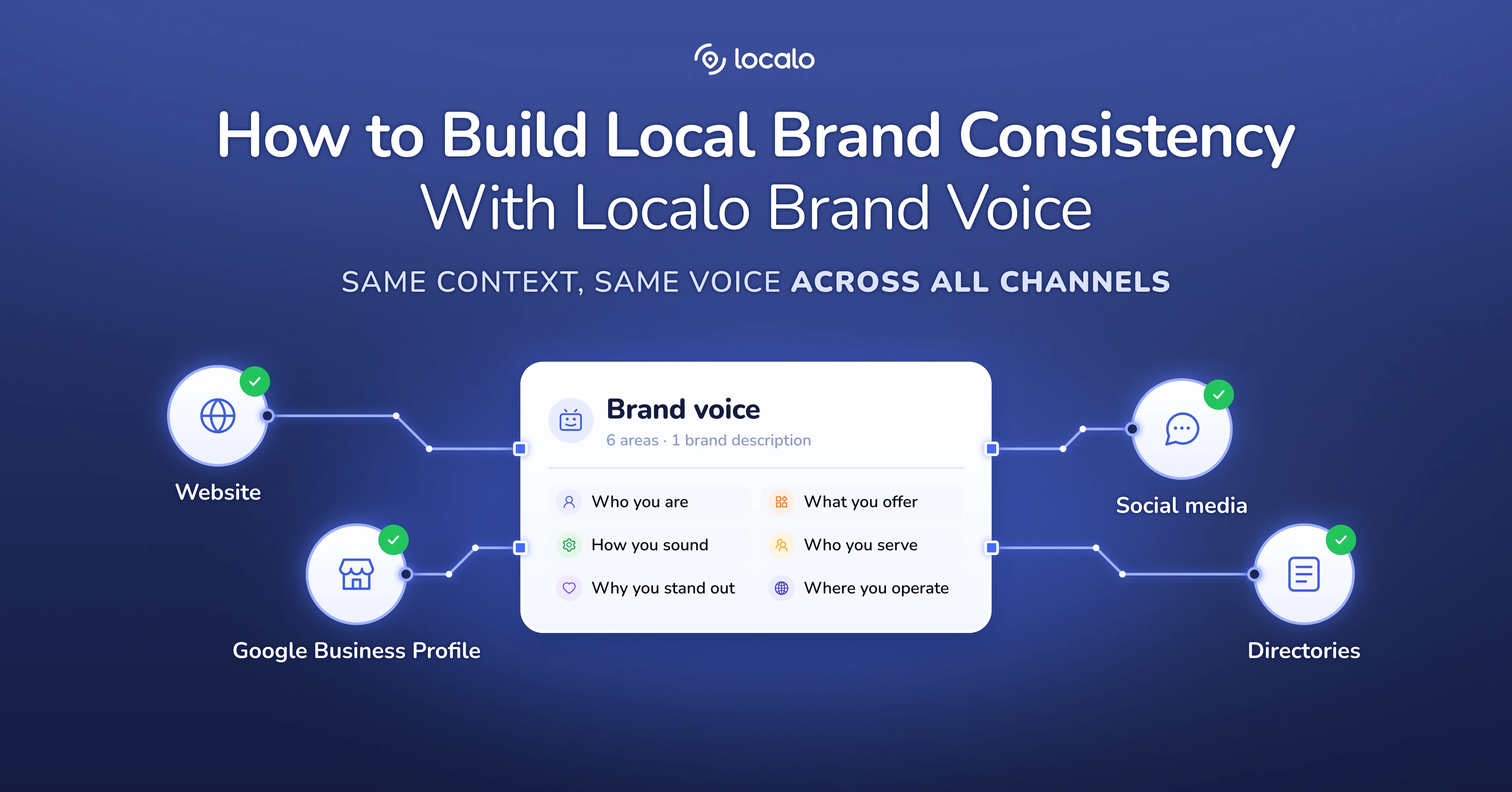
Localo extends traditional brand voice across 6 areas covering communication principles and the core facts about a business.
- Who you are: the business’s identity, role, ownership and credibility.
- How you sound: the brand’s personality, tone, style guidelines and preferred language.
- Why you stand out: the business’s differentiators, supporting evidence and reasons customers can trust it.
- What you offer: the business’s services, products and delivery methods.
- Whom you serve: the business’s audience segments, their needs and purchasing situations.
- Where you operate: the business’s local market, locations and service area.
These areas provide structured context for the Localo AI Agent. The agent can use this context to create posts, service descriptions, review responses and other content supporting the brand’s local presence.
How does Localo automatically build Brand Voice for a local business?
Localo automatically builds a local business’s Brand Voice through 4 stages, from data collection to description enrichment.
- Collect business information from its online presence.
- Analyze the industry and local competitors to establish a benchmark.
- Organize the information into a consistent structure for the brand description.
- Enrich the brand description through benchmarking and competitor comparison.
The Google Business Profile manager can review and edit the completed Brand Voice.
Stage 1: collect information from the business’s online presence
Localo collects information from 3 source types: the Google Business Profile, the business website and online mentions.
Each source provides a different kind of information. The Google Business Profile includes categories, services and reviews. The website expands on the offering, business and service delivery. External mentions provide further context and can support or challenge the business’s own statements.
Stage 2: analyze the industry and local competitors
Localo establishes a benchmark for the business by analyzing profiles from the following 2 groups of businesses.
- Businesses with the strongest visibility in the same industry category, regardless of location.
- Direct local competitors operating in the same market as the business being analyzed.
The benchmark helps identify which information to look for in the business’s data and which areas need more detail. Competitor information does not become factual information about the business being analyzed. The comparison serves only as a reference for interpreting the business’s own information.
Stage 3: organize the information into a consistent brand structure
Localo organizes the collected business information into the following 6 areas of the Brand Voice model.
- Who you are: the business’s identity, role, ownership and credibility.
- How you sound: the brand’s personality, tone, style guidelines and preferred language.
- Why you stand out: the business’s differentiators, supporting evidence and reasons customers can trust it.
- What you offer: the business’s services, products and delivery methods.
- Whom you serve: the business’s audience segments, their needs and purchasing situations.
- Where you operate: the business’s local market, locations and service area.
The system assigns information to the relevant areas and identifies contradictions between sources. Conflicting information can then be checked before it enters the completed brand description.
Stage 4: enrich the description through benchmarking and competitor analysis
Localo compares the structured business description with the industry benchmark and direct local competitors. The comparison identifies typical terminology, elements of the offering, customer needs and other important contexts.
How can you use Localo Brand Voice for effective communication?
Use Localo Brand Voice as shared brand context for creating different types of content with the Localo AI Agent. Consistency means preserving information, meaning and the way the business is presented while adapting the text to its purpose.
Google Business Profile
A Google Business Profile uses the same brand context across different content types. The business description provides an overview, while a service description explains one part of the offering. A post shares an update, and a review response addresses a customer’s experience.
A shared Brand Voice allows the purpose and format to change while keeping core business information consistent.
Social media
Social media uses the same brand context in shorter, more conversational content. Tone of voice can vary by publication type, while brand information remains consistent with Localo Brand Voice.
A post, story or comment reply can sound different from website content without changing the meaning of core brand information.
Business directories and external publications
Localo Brand Voice can serve as a reference description for business directories, partners and external publishers. A publication can shorten, expand or reformat the text while preserving accurate information about the offering, audiences and service area.
Shared context reduces conflicting, outdated or oversimplified descriptions of the same business across different sources.