
If you manage client Google Business Profiles as a specialist, freelancing or at an agency, you’ve felt what I’ve felt these last few months: the 2024 checklists suddenly stop working. The AI layer Google has placed over Search and Maps, plus outside LLMs like ChatGPT, Perplexity, and Claude, are now reading the GBP, the website, the reviews, and the social profiles of your client as a single data stream. Gemini decides whether to surface the business at all to a user looking for a service or product, and the Local Pack is now just one of several channels where your client’s end customer might find them. That’s the AI impact on local SEO this year: your job has shifted from “rank higher in the Local Pack” to “make sure Gemini has an accurate, well-documented picture of the client and can recommend them without hesitation.”
Different brief, different tasks, different definition of success. I’ve been doing local SEO since 2018. First at a marketing agency, where I built out the Local SEO division, now as co-founder of Localo. Below, you’ll get five concrete things: what the shift from page optimization to entity optimization actually means, why the “it’s not a ranking factor” argument stopped working, which fields in the Google Business Profile Gemini actually reads, how the March launch of Ask Maps works, and a five-step playbook for 2026, with concrete steps you can run on every client account in your portfolio. All tested on my own clients’ profiles, on Localo user accounts, and backed by research from Semrush, Whitespark, Near Media, and Search Engine Land.
From Pages and Signals to Entities: What AI Search Actually Changed
Two terms I’ll use throughout. Without them, the rest doesn’t make sense:
- Language model (LLM, large language model) is an AI system trained on a large body of text that reads, predicts, and generates responses in natural language. Gemini (Google’s engine), ChatGPT, Claude, and Perplexity are all LLMs.
- Entity in the Google sense is your client’s business treated as one object: a real business with a specific category, location, and contact details, described consistently in many places online. Not the website. Not the directory listing. The business as a whole.
Mike Blumenthal (Near Media, GatherUp), one of the most respected analysts in the industry, summed it up in his AmpUp 2025 conference talk: “Google isn’t ranking websites anymore. They’re ranking entities” (GatherUp, 2025). In practice: Google is searching for and surfacing a business with a specific category, tied to a location, described consistently across multiple sources, not a single web page. The distinction has been there for years (Knowledge Graph since 2012, E-E-A-T updates), but only now, when Gemini is generating the answers, does it become tangible in the daily work of a Local SEO specialist.
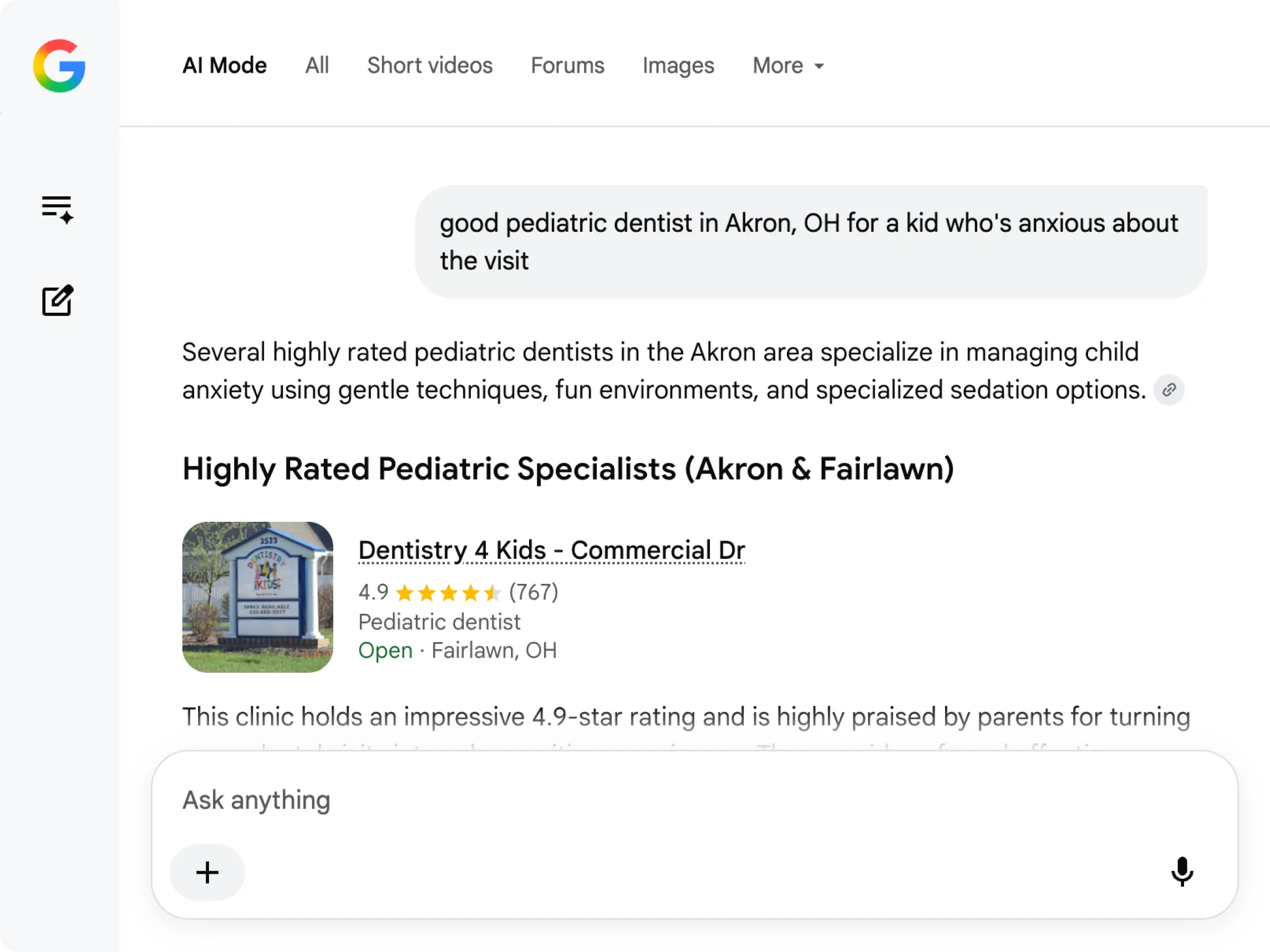
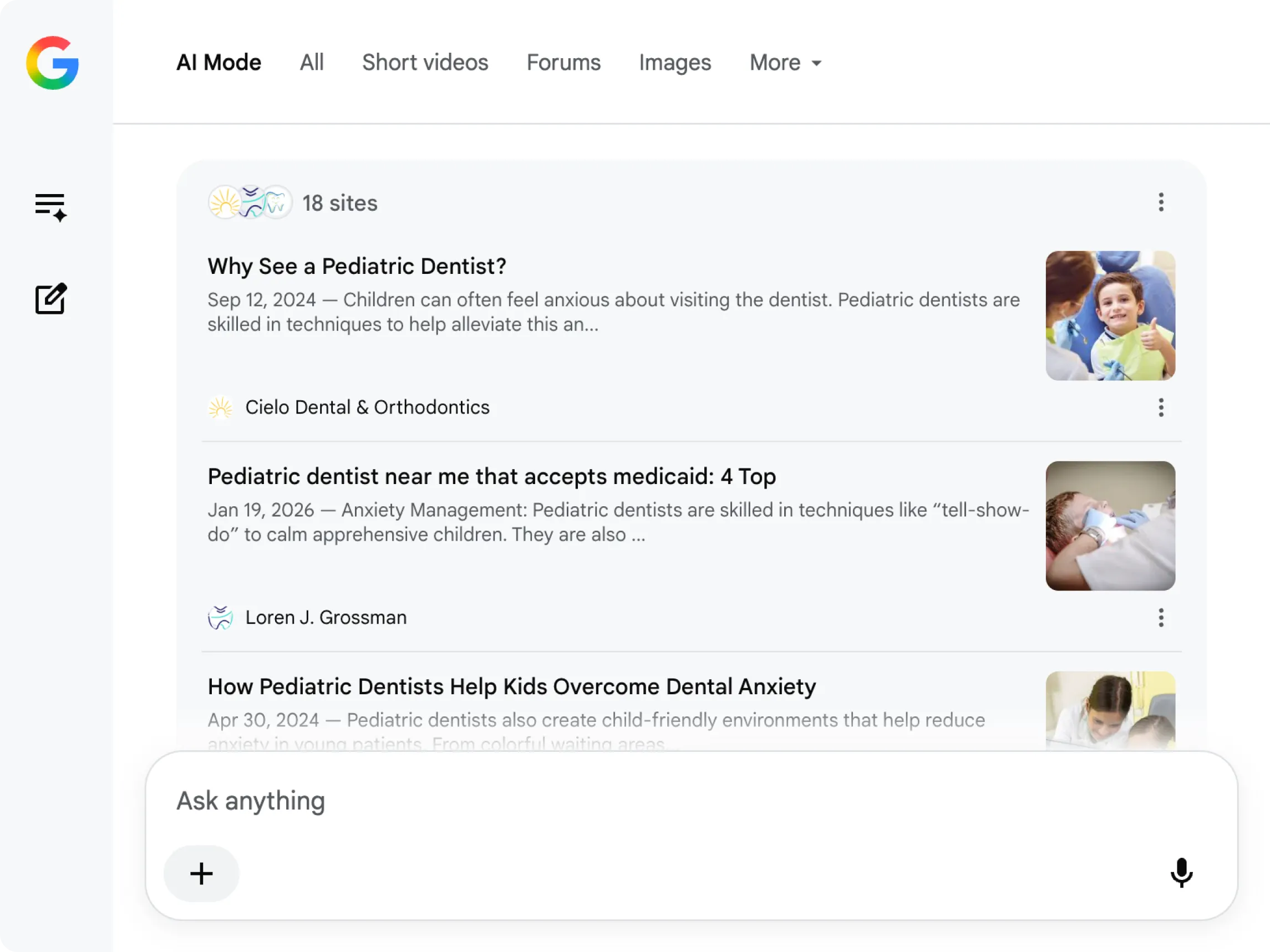
What this means in practice: when a user asks Google or Ask Maps a question like “good pediatric dentist in Akron, OH for a kid who’s anxious about the visit,” Gemini runs a decision loop in a fraction of a second:
- gathers candidates (nearby businesses in the right category),
- filters by attributes and context (“pediatric,” “anxious,” “Akron, OH”),
- scores each candidate business by completeness and consistency of information and by the content of reviews,
- picks the 3–5 businesses that best match the query and presents them to the user with a short justification.
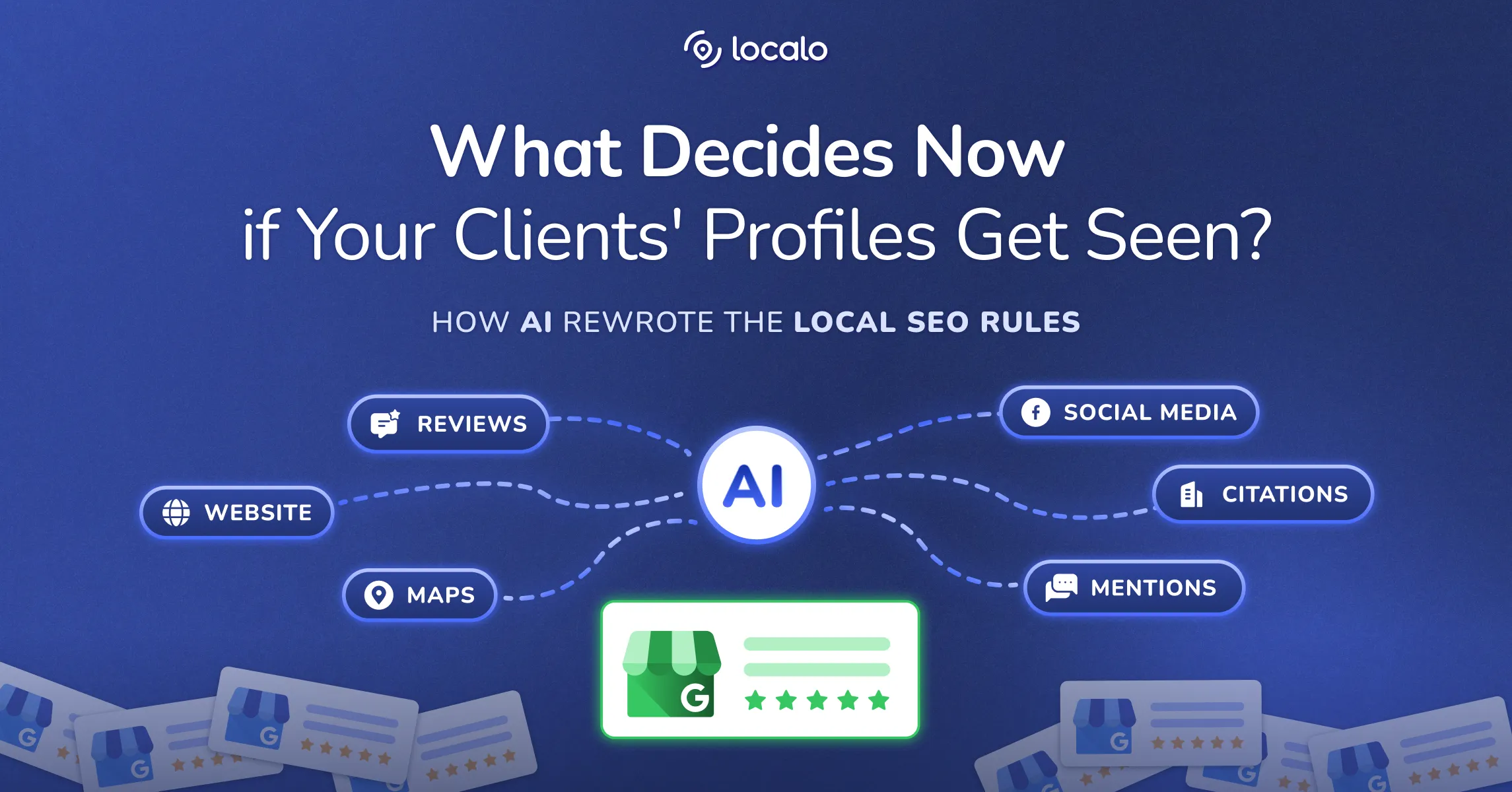
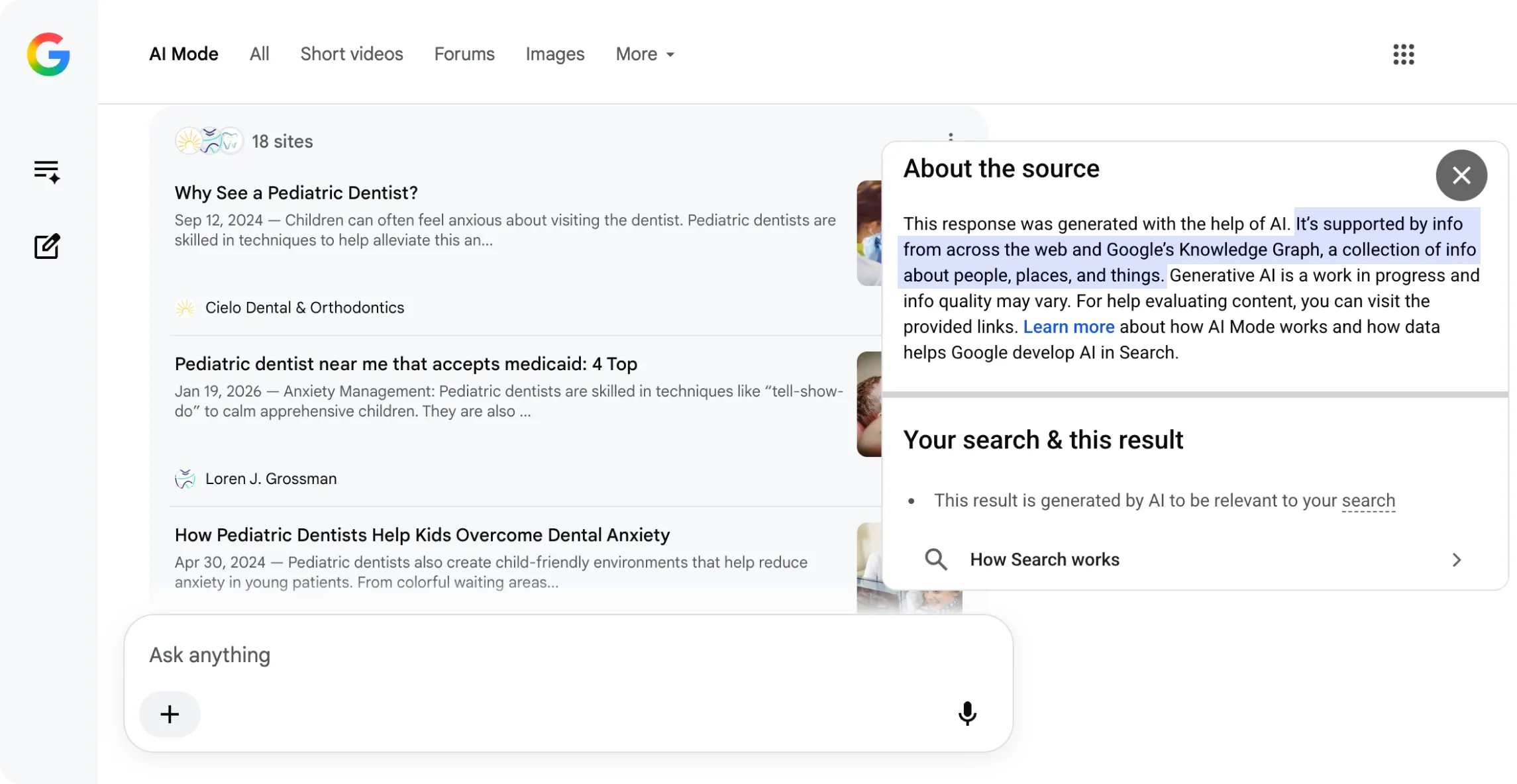
Gemini has stopped treating the Google Business Profile, the website, reviews, social mentions, and expert quotes as separate ranking signals. All of that is now one data stream about one entity. From that stream the model builds its representation of the business. The more complete and consistent that representation is, the more confidently the AI recommends the client. The more gaps and contradictions in it, the more easily Gemini reaches for a competitor it has more data on when answering the user.
Four Places Where You Can See This
- AI Overviews in Google results are showing up more and more on local queries like “best dentist Austin” or “car AC repair Phoenix.” Per Semrush’s study of 10M+ keywords (global data, November 2025), AI Overviews appeared on 15.69% of queries. Organic CTR drops sharply when they’re present: Seer Interactive’s 15-month analysis of informational queries reports a 61% decline (from 1.76% to 0.61%). Pew Research, on a sample of 68,879 real US queries, found that when an AI Overview appears, users click a classic result only 8% of the time vs. 15% without.
- AI Mode and conversational mode in Google Search, where Gemini answers directly. The same Pew Research study found that when an AI Overview appears in results, the user ends the session after visiting a page 26% of the time vs. 16% without. In other words: more and more sessions end inside the AI panel.
- Ask Maps inside Google Maps, which gets its own section below, since for me it’s the most consequential change in local search this year.
- Other LLMs (ChatGPT, Perplexity, Claude). In my own work, I see these models reaching primarily for Google Business Profiles, websites, industry directories, and reviews when handling queries like “good mechanic near me,” and that’s what they build their answer from. This is my observation from testing, not a published study. I don’t yet have a publicly audited dataset, so treat it as my read from the contexts I work in.
The takeaway for you as a specialist: the question is no longer “where does my client rank in the Local Pack?” The question is: “Is my client’s business clear and consistent enough for AI that Gemini can confidently tell a user: go there?” If it isn’t, the client drops out of every results channel at once: AI Overviews, Ask Maps, ChatGPT, Perplexity.

Why “It’s Not a Ranking Factor” Stopped Being a Valid Excuse
In the Local SEO community, I’ve watched the same conversation play out for years. Someone asks “do Posts affect rankings?” Someone else cites the Sterling Sky study and replies, “no, Posts don’t move position in the Local Pack.” Technically they’re right, and Joy Hawkins showed it in black and white in a controlled test.
But in 2026, that’s nowhere near enough. “Not a direct ranking factor” stopped being equal to “doesn’t matter.” In my work across a client portfolio, I see that Posts, attributes, additional categories, business description, social media links, and on-site FAQs may not move position in the classic Local Pack by a single spot. But they directly feed the AI search layer that decides whether the client shows up in Ask Maps, in an AI Overview, or in ChatGPT’s answer to “good roofer in Chicago.”
This is, in my view, the key 2026 distinction, and one I try to drill into every specialist I work with: ranking in the Local Pack is now just one of several ways an end customer finds your client’s business. The second is getting mentioned in AI answers. The third is a direct recommendation in a Gemini, ChatGPT, or Perplexity conversation. Only the first can be cleanly bought with “algorithm-targeted” optimization. The other two require a full, honest, descriptive presence.
Concrete items that “didn’t matter” a year or two ago and are now mandatory on every client profile in my work:
- A full business description with specifics. What the client does, who they serve, where, in what situations, what sets them apart. Not “20 years in business, professional service.” Specific situations, specific specializations, specific locations.
- All matching additional categories, not just the one primary. Google Business Profile lets you add up to nine additional. Most client profiles I audit have one or two.
- Attributes (parking, wheelchair access, accepted payments, vegan menu, dog-friendly). Gemini and Ask Maps use these as first-pass filters to match queries like “coffee shop with Wi-Fi and a quiet place to work, pet-friendly.”
- A Services and Products section with specific names and descriptions. Every service description is literally text Gemini can quote back in an answer.
- Posts roughly once a week. Even if they don’t move position, they’re a signal to Gemini of activity and fresh information.
- FAQ on the website, answers to the questions an end customer might actually ask AI.
Whitespark, in its 2026 Local Search Ranking Factors report, puts proximity in the top spot (~55% weight), with GBP signals combined in second (~32%) for the classic Local Pack. More importantly: for the first time in the report’s history, a separate “AI Search Visibility” category has been introduced, where on-page (the client’s website) weighs heaviest at 24%. GBP weight in that second category drops to 12%. The takeaway for your work: under AI visibility, you have to start optimizing two things at the same time, the GBP and the site.
What Gemini and AI Overviews Read From a Client’s Google Business Profile
Strictly practical, because the question I get most often from other specialists is: “OK, but what specifically do I fill in on the client’s account so AI likes it?”
From research by Search Engine Land (Rich Sanger, April 2026), Glenn Gabe / GSQi (briefing with the Gemini team, March 2026), and Near Media (Blumenthal, Sterling, April 2026), plus my own observations across the hundreds of accounts I see in Localo, Gemini (the engine behind AI Overviews and Ask Maps) reaches for specific data:
1. Google Business Profile
- Primary and additional categories. These decide whether the client even enters the candidate pool for a given query.
- NAP and opening hours (including special holiday hours): the business’s “ID card.” Has to match everywhere, between the GBP, the website, and the directories.
- Business description. 750 characters to say who the client is. Don’t waste them by stuffing keywords.
- Service list with descriptions. Each service is a separate “fact” AI can quote back in an answer.
- Attributes and Products. First-line filters for AI search.
- Photos and Vision AI (Vision AI = Google systems that understand what’s in a photo without needing a description). Show real interiors, real dishes, real teams. Stock and AI-generated images get recognized and treated as a weak-authenticity signal.
- Posts (What’s New, Offers, Events, Products): roughly once a week, covering different topics, not just promotions.
- Reviews (detailed and specific). A review like “Sarah was great with our 7-year-old lab who normally freaks out at the vet’s office” is four concrete facts for AI (specialization, dog’s age, breed, behavioral issue). A review like “great service, recommended” is zero facts, nothing to quote.
2. The Website
- Consistent NAP (Name, Address, Phone) with the Google Business Profile.
- Schema markup, primarily LocalBusiness with the sameAs section filled in, pointing to the business’s profiles on other platforms (Facebook, industry directories). Helps AI recognize the entity and link it across sources into one.
- FAQ written as real customer questions: “Do you service cars under warranty?”, “How long is the wait for an appointment?”. A good FAQ is one of the better single investments under AI search.
- Service and location pages: each service and each location should have its own subpage, well placed in navigation.
3. External Sources (When Local Data Is Thin)
- Social media. Per Semrush’s research on the most-cited domains in LLMs, the most-cited by AI are Facebook, LinkedIn, and Instagram.
- Industry and local directories.
- Articles, press mentions, and blogs.
Mike Blumenthal and Greg Sterling, in the same Near Memo episode, put it well: “Your website becomes a data source for AI.” That doesn’t mean the client’s site stops being needed. It means its role is no longer just to convert. It’s also to feed AI search with data about the business.
Old Local SEO Playbook vs. the New AI-Driven One
The fastest way to see what actually changed in daily work: a side-by-side of how Google Business Profile elements were treated in classic Local SEO versus how they work in the era of AI search. Same field, two different worlds.
| Google Business Profile Element | Classic Local SEO (2018–2024) | AI Search Era (2025+) |
|---|---|---|
| Posts (GBP Posts) | Considered “not a ranking factor.” Skipped by many specialists. | Quoted by Gemini and Ask Maps in answers. |
| Service descriptions | Often ignored or filled in with just the service names. | Key field for matching long, natural-language queries like “X without Y in location Z.” |
| Attributes | Trivia. Added “if there’s time.” | First filter Ask Maps applies to queries like “coffee shop with Wi-Fi and quiet for work.” |
| Review content | Mostly the count and the stars. | Content of reviews = data to interpret. “Great at handling old wiring in older homes” = three facts AI can quote. |
| Social media links in GBP | Cosmetic, no ranking impact. | Entity-verification signal. AI checks whether the business consistently exists across channels. |
| FAQ on the website | Welcome, not critical. | Direct Q+A feed to AI. The single best small investment under AI search. |
| Schema markup | For rich snippets in the SERP. | A trust signal in entity recognition. Gemini uses it for grounding (= anchoring its answers in verified, structured data). |
Every row on the right is something that, a year ago, took 5–10 minutes per profile and probably went unnoticed. Today each of those items decides whether AI even names the client’s business in an answer. This isn’t extra work. This is the core work.
Why Ask Maps Changes the Stakes for Every Local SEO Specialist
This is the part that for me personally is the biggest shift in local SEO since the introduction of the Local Pack. I spent a lot of time in March and April 2026 testing Ask Maps on US accounts and comparing notes with Mike Blumenthal (Near Media), Joy Hawkins (Sterling Sky), and analysts at BrightLocal.
What Ask Maps Officially Is
On March 12, 2026, Google announced on its corporate blog the launch of Ask Maps, a conversational AI layer built directly into the Google Maps app. The feature uses Gemini models and lets you ask Maps questions in natural language that the “classic” map could never answer (TechCrunch, March 12, 2026; Search Engine Journal).
A few facts officially confirmed by Google:
- Launch: March 12, 2026, in the US and India, Android and iOS. Desktop version “coming soon.” Android Auto, CarPlay, and Google Built-in scheduled for the following months.
- Rest of world: no official date. Europe and other markets are likely to get the feature in waves, after compatibility with regional regulations is settled. Google won’t necessarily announce these timelines in advance.
- How it activates: in the Google Maps app, an “Ask Maps” chip appears in the first position under the search bar. You can type or speak.
For US-based readers: this matters because you are the launch market. The window where pure data quality wins, before ads enter the surface, is right now in your market, not “someday.”
What Ask Maps Actually Does
In its official help article, Google gives three example queries:
- “Any fun things to do this weekend within a 15-minute drive?”
- “I need to pick up my friend from the airport. What’s the fastest way? When should I leave if I need to be there by 6 PM? Where can I get flowers on the way?”
- “My phone is about to run out of battery. Where can I buy a charger? Are there any charging stations available at no charge without having to order a coffee?”
Notice what those questions are. They aren’t keyphrases. They are scenarios, with time, context, emotion, and constraints. That’s the whole shift: Ask Maps has to understand intent, proximity, opening hours, attributes, prices, reviews, and user history at the same time, then pick just a few businesses that best handle the situation.
Where Ask Maps Gets Its Data
Here we have broad agreement between Google’s official documentation and independent testing, including Sanger’s study cited above. The caveat Sanger himself flags: his tests cover a limited set of service queries in one US region, so this is directional, not full research. With that noted, the source hierarchy looks like this:
- Google Business Profile. The first and most important layer: categories, description, services, products, attributes, hours, photos, posts.
- Google reviews. Gemini pulls specific phrases from review content, things like “they show up on time,” “they don’t upcharge,” “great at handling old wiring in older homes.” Sanger shows it’s the language of reviews, not the count of stars, that shapes how Ask Maps describes a business.
- The client’s website, especially service pages and FAQs. Weight grows with the complexity and price of the query: small for “coffee shop nearby,” significant for “central heating system replacement” or “wiring modernization in an older home.”
- External sources. Facebook, YouTube, and industry platforms like Angi and HomeAdvisor. AI reaches for these mainly when the query is a high-trust one (expensive, risky, infrequent services) and needs additional proof beyond the Business Profile.
What Concretely Changes in Your Work for Clients
Quoting Sanger again: “Ask Maps narrows the field and adds interpretation.” In tests across five intent levels, the average number of surfaced businesses was 3.3–5.0. Not 20. Not 10. Three to five.
What this means for your client portfolio:
- No room for “good enough” businesses. If a client profile is incomplete, NAP is inconsistent across sources, reviews are generic, and the website has no FAQ, the client drops out of Gemini’s recommendation set.
- Review text > star count. I have a dental client in my portfolio with 4.7 stars and 230 reviews who performs worse in Ask Maps tests than a competitor at 4.5 with 90 reviews, because the competitor’s 90 reviews describe specific procedures, situations, and patient concerns. That’s raw data for Gemini.
- Attributes are the new “first-line filter.” If someone asks “coffee shop with good Wi-Fi and quiet for work,” AI reaches for the “Wi-Fi” and “good for remote work” attributes first. Not the business description.
- The client’s website still matters, especially for pricier, more expert services. Where Gemini needs expertise evidence, it reaches deeper into the site.
And one thing the ad ecosystem doesn’t yet want to say out loud: during the briefing cited above, Glenn Gabe asked the Gemini team straight out about ads. The Gemini team’s response: no ads in Ask Maps for now, but Google isn’t ruling them out later. In other words: there’s a window right now where pure data quality wins. Later, that may change.
The bottom line from Ask Maps: in 2026, the work of a Local SEO specialist is no longer fighting for ranking on three keywords. It’s describing the client’s business in enough detail and with enough consistency that AI can confidently tell the user: go there. How to do that operationally: five points below.
Five-Step AI-Driven Local Visibility Playbook for 2026
After eight-plus years in Local SEO, auditing client accounts in Localo, and testing changes across hundreds of local profiles, I know one thing: in 2026, you don’t need a 200-item checklist. You need five things you do consistently on every client account. The rest is noise.
1. Close Out the Fundamentals of the Client’s Google Business Profile
The hard foundation, without which the rest doesn’t matter. Fill in literally every field in the client’s GBP:
- Primary category: the most specific one available, plus every additional category that fits the business.
- Business description: 600–750 characters, specific, describing who the client serves, where, what they do, how, and what sets them apart.
- All services with their own descriptions.
- All matching attributes (payments, accessibility, character of the place).
- Opening hours plus special hours for holidays and vacation.
- New photos every month.
- A link to the website plus links to the client’s social media (Facebook, Instagram, LinkedIn).
Profiles with a complete, verified business listing are much more likely to surface than incomplete ones, a finding confirmed by both Google’s documentation and the Whitespark 2026 report cited above. This isn’t “nice to have.” It’s the baseline.
2. Run a Deliberate Review-Generation Program for the Client, Not “We Ask Sometimes, When We Remember”
Reviews in 2026 are no longer just a number. They’re a stream plus a vocabulary. On the client’s account, run:
- A volume target: new reviews every month, not 20 in one week and silence afterward (that’s a bad signal).
- A quality target: ask end customers about a specific situation, not a general opinion. “What exactly worked for you?” or “What problem did you bring to us?”
- Personalized responses to every review. No template.
You don’t need more five-star reviews for the client. You need more truthful, descriptive ones. As Mike Blumenthal put it in the same GatherUp interview: “You don’t need more five-star reviews. You need more truthful ones.”
3. Treat the Client’s Website as Infrastructure That Feeds AI
The website in 2026 isn’t a brochure. It’s the entity’s “passport,” what you use to feed Gemini, ChatGPT, Perplexity, and other models. What it has to include:
- Consistent NAP with the Google Business Profile. This is critical.
- An embedded Google profile map (for instance on the contact page).
- Schema markup: LocalBusiness at minimum.
- Service pages with specific descriptions.
- FAQ written like a real conversation with a customer. The single best investment under AI. Not “what are your prices?” Closer to “do you service cars under warranty?”, “what payment methods do you take?”, “what should I do if A happens with B on a Friday night?”
- Fresh blog updates.
4. Build a Directory and Mention Network Outside the Client’s Profile
The profile and the website are the client’s property. Directory listings and brand mentions on external sites are additional proof that the business exists in the real world. AI models literally reach for these for training and for grounding responses.
- Classic NAP mentions: industry directories, local directories, local press.
- Social media profiles linked from the Google Business Profile: Facebook, Instagram, LinkedIn, YouTube.
- Reviews across different platforms, not just Google.
5. Make Activity and Freshness an Operational Habit
This is the step where even accounts with the best profiles fall apart. They start strong, then stop “feeding” the system. In the AI era, Google weights the last few months more heavily than the profile’s entire history.
Based on my own observations and conversations with other Local SEO specialists, profiles that consistently publish posts, add photos, and update information for several months in a row show notably higher visibility in the Local Pack and surface more often in AI answers than profiles that “fall asleep” after the startup phase. The algorithm and Gemini interpret a lack of activity as a drop in the business’s activity. Here’s what I recommend:
- Posts: at minimum 1×/week.
- New photos every month.
- Hours updates: holidays, vacations, public holidays (each is an additional freshness signal).
- Update services and products whenever something changes.
- Update the business description whenever something changes.
In Localo, that’s exactly how we built Smart Tasks and the Audit. We look at what’s missing on the client’s profile relative to Google’s guidelines, best practices, and top-ranking competitors, and we hand you a concrete action plan. From my own work: without consistency, the other four points slowly fall apart.
Summary
The new AI search world in local SEO rewards exactly the same things that worked in 2018: a complete profile, real reviews, a real website, consistency. What’s changed is the stake. Consistency in “feeding the data” doesn’t just improve ranking now. It decides whether the client’s business appears at all in the answer Gemini, Ask Maps, or ChatGPT hands the end customer on a plate.
Starting now, while Ask Maps is still ad-free in the US market, gives your clients an edge over the competitors who’ll only start working on this when they see the drop in clients despite the same Local Pack positions.
If you want to automate local SEO work while keeping the client’s data complete and consistent, try Localo.